On November 2, 1917, the British wartime cabinet issued the infamous Balfour Declaration. I quote it here in full:
"Dear Lord Rothschild,
I have much pleasure in conveying to you on behalf of his Majesty's Government the following declaration of sympathy with Jewish Zionist aspirations, which has been submitted to and approved by the cabinet.
His Majesty's Government view with favour the establishment in Palestine of a national home for the Jewish people, and will use their best endeavours to facilitate the achievement of this object, it being clearly understood that nothing shall be done which may prejudice the civil and religious rights of existing non-Jewish communities in Palestine or the rights and political status enjoyed by Jews in any other country.
I should be grateful if you would bring this Declaration to the knowledge of the Zionist Federation,
Yours sincerely, Arthur James Balfour."
J.M.N Jeffries analysis of this document in Chapter XI of his book Palestine: The Reality (1939) is, of course, the definitive account of the document's deceptions and can be accessed on this blog in its entirety under the label JMN Jeffries.
I note only here the following words of Jeffries with respect to the above clause:
"That their religious rights should not be prejudiced, indeed, was satisfactory, though there was not very much in that. Happily, it could be taken for granted. Wherever Britain rules religious rights are preserved.
"The crux arrives with 'civil rights.' What are 'civil rights'? all turns on this point. If civil rights remain undefined it is only a mockery to guarantee them. To guarantee anything, and at the same time not to let anyone know what it is, that is Alice in Wonderland legislation. 'I guarantee your civil rights,' said the White Queen to Alice in Palestine-land. 'Oh, thank you!' said Alice, 'what are they, please?' 'I'm sure I can't tell you, my dear,' said the White Queen, 'but I'll guarantee very hard.'
"If only the Declaration had been as innocent as the text of Alice in Wonderland. Its nonsense is deceptive nonsense, written with vicious intention. The Arabs were guaranteed civil rights, again because to the unalert ear it sounded as though they were being assured a man's normal rights, the freedom to choose the government of his country which every decent man should enjoy, the common political rights of a democratic regime.
"But in fact the Arabs were not assured these at all. The effect, and the aim, of the clause actually was to withdraw from the Arabs (fighting or suffering for us at the time under promise of independence) those very rights of independence for which they had contracted; to say nothing of their natural title to them. By sleight of tongue civil rights were substituted for political rights... As practice went, 'civil rights' was an expression which was left without any interpretation, and so had no existence as a surety or guarantee at all." (p 179)
Now if we turn to the Foreword of Trump son-in-law Jared Kushner's slick Peace to Prosperity: The Economic Plan: A New Vision for the Palestinian People document, issued by the Trump White House, we see that the entire panoply of international law upon which the Palestinian case has hitherto rested since the Nakba of 1948 would be swept willy-nilly into the proverbial dustbin of history, and be replaced with the flakiest load of neoliberal economic jargon ever seen since the advent of that malign and soul-destroying ideology (the upper case bolds, btw, are Kushner's):
Kushner's Economic Plan touts three initiatives:
"The first... will UNLEASH THE ECONOMIC POTENTIAL of the Palestinians... The second... will EMPOWER THE PALESTINIAN PEOPLE to realize their ambitions.... The third... will ENHANCE PALESTINIAN GOVERNANCE, improving the public sector's ability to serve its citizens and enable private-sector growth."
"These three initiatives," declares Kushner, "are more than just a vision of a promising future for the Palestinian people - they are also the foundation for an implementable plan. Capital raised through this international effort will be placed into a new fund administered by an established multilateral development bank. Accountability, transparency, anti-corruption, and conditionality safeguards will protect investments and ensure that capital is allocated efficiently and effectively. The fund's leadership will work with beneficiary countries to outline annual investment guidelines, development goals, and governance reforms that will support project implementation on the areas identified within Peace to Prosperity. Grants, occasional loans, and other support will be distributed to projects that meet the defined criteria through a streamlined process that will enable both flexibility and accountability."
Note that at no point in the above is Israel itself expected to foot the bill for its decades-long crimes against the Palestinian people. This 'thinking' is the equivalent of Israel wanting Iran crushed, and wanting the Americans to do it for them, mentioned in my previous post Morrison Itching to Attack Iran.
Now the following may seem like something of an historical detour - however, the long history of Palestine matters if we are to understand its present history.
One of the first British intellectuals to be persuaded to visit Palestine in 1919 by the Zionist movement was G.K. Chesterton (1874-1936), the prominent writer, philosopher, novelist, essayist, and convert from High Church Anglicanism to Catholicism.
But, unlike so many who have been on propaganda tours to the Holy Land since they were first organised by Britain's political Zionists in 1918, Chesterton was a remarkably independent observer and one not at all afraid to voice his reservations about the contradictions he found between the goals of political Zionism, as represented in the person of Dr Chaim Weizmann (Balfour's interlocutor), and the legitimate fear of the Palestinian Arabs with respect to those goals. The following extract echoes both Chesterton's partiality towards political Zionism as well as his capacity to see things through Palestinian Arab eyes. It comes from his book The New Jerusalem (1920):
"If the Zionists wish to quiet the fears of the Arabs, surely the first thing to do is discover what the Arabs are afraid of. And very little investigation will reveal the simple truth that they are very much afraid of sharks; and that in their book of symbolic or heraldic zoology it is the Jew who is adorned with the dorsal fin and the crescent of cruel teeth... But the case is yet more curious than that. These simple tribes are afraid, not only of the dorsal fin and dental arrangements which Dr. Weizmann may say (with some justice) that he has not got; they are also afraid of the other things which he says he has got. They maybe in error, at the first superficial glance, in mistaking a respectable professor for a shark. But they can hardly be mistaken in attributing to the respectable professor what he himself considers as his claims to respect. And as the imagery about the shark may be too metaphorical... there is not the smallest difficulty in stating in plain words what the Arabs fear in the Jews. They fear, in exact terms, their knowledge and their experience and their money. The Arabs fear exactly the three things which he says they need. Only the Arabs would call it financial trickery and an experience of political intrigue, and the power given by hoards of money not only of their own but of other peoples. About Dr. Weizmann and the true Zionists this is self-evidently unjust; but about Jewish influence of the more visible and vulgar kind it has to be proved to be unjust." (pp 200-01)
IOW, there was never a point in the history of modern Palestine when Palestinians had nothing to fear from the Zionist settler-colonial entity planted in their midst first by the British, and, since the time of US president Truman, maintained, vastly expanded and made infinitely more violent towards the indigenous Palestinians by the United States.
So, in sum, what we have here with Kushner's Plan is a new Balfour Declaration, but one without even the spurious "civil and religious rights" exposed by Jeffries in Palestine: The Reality.
In fact, Kushner's Plan resembles nothing so much as a variation on the Australian Coalition government's oft-repeated mantra, 'jobs and growth'.
Showing posts with label JMN Jeffries. Show all posts
Showing posts with label JMN Jeffries. Show all posts
Friday, June 28, 2019


Sunday, November 11, 2018
What My Mind Turns to on Armistice Day
In his peerless work on the perfidious Balfour Declaration of 1917 and the appalling consequences for Palestine and its people that flowed (and continue to flow) therefrom, Palestine: The Reality (1939), British historian J.M.N. Jeffries wrote these justifiably angry words:
"The underlying assumption of [a certain line of 'thought' peddled by the Anglo-Zionist establishment of 1920-23] is that the soldiers who fell in Palestine fell fighting to provide there that form of government which [wartime prime minister] Lloyd George installed. The 5th Norfolks, the 8th Hampshires bled so that the Sevres Treaty might not die: the men of the 53rd Division left six hundred casualties on the Samson Ridge so that the nine subterfuges of the Balfour Declaration might pass unchallenged: the Australian Light Horse charged crying, Advance the National Home! Was anything further from the truth? We know why our soldiers died - in loyalty to their country." (p 402)
My first inkling that this old Zionist myth, stripped of course of its British references, was being recycled here in Australia came when I read the following in 2008:
"The ties that bind Jerusalem and Canberra were further cemented with the commemoration last November of the 90th anniversary of the Charge of the Australian Light Horse brigade [31/10/07], when brave Aussie Diggers trounced the Turks at Be'er Sheva, paving the way for the capture of Jerusalem... And it is in Be'er Sheva that Richard Pratt is ploughing funds to build the Park of the Australian Soldier - a permanent memorial to those who died in battle for the Jewish state." (Editorial by Dan Goldberg, Rhapsody: Linking Culture between Israel & Australia, Jan-Mar 2008)
I had stumbled upon what might be termed a 'zombie myth' - long buried, effectively forgotten (but for Jeffries' mention), dug up decades later, dusted off, and re-purposed for another use, but retaining still the core propaganda trope of the original. After all these years, whether with or without external involvement, Pratt Foundation CEO Sam Lipski and his cardboard king (Visy Industries) boss and prominent Zionist donor to the Labor and Liberal parties, the late Dick Pratt, had come up with a neat way of "cementing" - mark that word! - alleged "binding ties" between Israel and Australia when Pratt funded the construction of the Park of the Australian Soldier in Be'er Sheva*. This has now become the point of dissemination of the zombie myth to thousands of clueless Australians, especially politicians, who flock to Be'er Sheva annually.
Never have Zionist PR merchants managed anything quite like this in any country, except perhaps in fostering the myth of 'lost Jewish tribes' in many of our South Pacific neighbours.
For my exploration of this phenomenon, just click on the AIF label below.
[*Of course 'Be'er Sheva' simply did not exist in 1917. Back then it was the Palestinian Arab town of Beersheba. Hopefully, one day, it will return to its old self.]
"The underlying assumption of [a certain line of 'thought' peddled by the Anglo-Zionist establishment of 1920-23] is that the soldiers who fell in Palestine fell fighting to provide there that form of government which [wartime prime minister] Lloyd George installed. The 5th Norfolks, the 8th Hampshires bled so that the Sevres Treaty might not die: the men of the 53rd Division left six hundred casualties on the Samson Ridge so that the nine subterfuges of the Balfour Declaration might pass unchallenged: the Australian Light Horse charged crying, Advance the National Home! Was anything further from the truth? We know why our soldiers died - in loyalty to their country." (p 402)
My first inkling that this old Zionist myth, stripped of course of its British references, was being recycled here in Australia came when I read the following in 2008:
"The ties that bind Jerusalem and Canberra were further cemented with the commemoration last November of the 90th anniversary of the Charge of the Australian Light Horse brigade [31/10/07], when brave Aussie Diggers trounced the Turks at Be'er Sheva, paving the way for the capture of Jerusalem... And it is in Be'er Sheva that Richard Pratt is ploughing funds to build the Park of the Australian Soldier - a permanent memorial to those who died in battle for the Jewish state." (Editorial by Dan Goldberg, Rhapsody: Linking Culture between Israel & Australia, Jan-Mar 2008)
I had stumbled upon what might be termed a 'zombie myth' - long buried, effectively forgotten (but for Jeffries' mention), dug up decades later, dusted off, and re-purposed for another use, but retaining still the core propaganda trope of the original. After all these years, whether with or without external involvement, Pratt Foundation CEO Sam Lipski and his cardboard king (Visy Industries) boss and prominent Zionist donor to the Labor and Liberal parties, the late Dick Pratt, had come up with a neat way of "cementing" - mark that word! - alleged "binding ties" between Israel and Australia when Pratt funded the construction of the Park of the Australian Soldier in Be'er Sheva*. This has now become the point of dissemination of the zombie myth to thousands of clueless Australians, especially politicians, who flock to Be'er Sheva annually.
Never have Zionist PR merchants managed anything quite like this in any country, except perhaps in fostering the myth of 'lost Jewish tribes' in many of our South Pacific neighbours.
For my exploration of this phenomenon, just click on the AIF label below.
[*Of course 'Be'er Sheva' simply did not exist in 1917. Back then it was the Palestinian Arab town of Beersheba. Hopefully, one day, it will return to its old self.]
Tuesday, July 24, 2018
Spinning Israel's Jewish Nation-State Law
Editorial commentary in support of each and every Israeli turn of the screw is, to say the least, conspicuous by its presence in Murdoch's Australian, yet on the subject of the apartheid state's latest addition to its 50+ apartheid laws, the nation-state law, The Australian's editor has so far said zip.
Yesterday, however, The Australian published an opinion piece (Illiberalism lies with the critics of Jewish nation-state law, 23/7/18) in defence of the legislation by one, Eugene Kontorovich, described as "a scholar at the Jerusalem think tank Kohelet Policy Forum." (This outfit describes itself on its website as "striving to secure Israel's future as the nation-state of the Jewish people, strengthening representative democracy, and broadening individual liberty and free market principles in Israel.")
Kontorovich would have us believe that:
"... Israel's Basic Law would not be out of place among the liberal democratic constitutions of Europe - which include similar provisions that have not aroused controversy... Consider the Slovak constitution, which opens with the words, 'We the Slovak nation', and lays claim to 'the natural right of nations to self-determination'."
What he omits to mention, of course, is that, unlike Slovakia, there is nothing 'natural' about Israel or its political evolution. Slovakia's emergence as a nation was a natural progression following the breakup of the old Austro-Hungarian Empire in World War I and was based on the Wilsonian principle of national self-determination. The same natural process should have been applied to Palestine under Article 22 of the Covenant of the League of Nations: "Certain communities formerly belonging to the Turkish Empire have reached a stage of development where their existence as independent nations can be provisionally recognised subject to the rendering of administrative advice... by a Mandatory until such time as they are able to stand alone. The wishes of these communities must be a principal consideration in the selection of the Mandatory."
Instead, the Palestinians were deliberately denied their 'natural right to self-determination', first by the British on behalf of the Zionist settlers who were allowed to flood into Palestine from 1918 on, and then by the Zionist settler state of Israel following the military takeover and ethnic cleansing of most of Palestine by Zionist terror gangs in 1948. As Britain's foreign secretary, Arthur James Balfour (of Balfour Declaration infamy) wrote in 1919: "The contradiction between the letters of the Covenant and the policies of the Allies is even more flagrant in the case of the 'independent nation' of Palestine... For in Palestine we do not propose even to go through the form of consulting the wishes of the present inhabitants of the country..."
But there's more. Why are we all up-in-arms about Israeli settlements? After all, they had the blessing of the - wait for it! - League of Nations:
"Another controversial provision of the law declares 'the development of Jewish settlement' to be a national value that the government should promote. It is understood to refer to encouraging population dispersion into the periphery of the country. This essentially restates policy adopted by the international community in 1922 in the League of Nations Mandate for Palestine, which sought to 'encourage... close settlement by Jews'."
More sins of omission:
1) The League of Nations, from its inception, was little more than a rubber stamp in the hands of the two post WWI imperial powers, Britain and France.
2) The Palestine Mandate was given to Britain... by Britain. As to its composition, the great J.M.N. Jeffries revealed: "The Mandate followed the precedent of the Balfour Declaration [which was incorporated into the text of the Mandate]. It was drafted in quiet between the [British] Government and the Zionists, mostly by the Zionists, and then it was issued under the cover of the League of Nations, as though it were the result of the collected debates of the world's lawgivers." (Palestine: The Reality (1939), pp 522-23)
Note also the angry words of Britain's then foreign secretary Lord Curzon, who said of the draft Mandate: "Acting upon (? against) the noble principle of self-determination and ending with a splendid appeal to the League of Nations, we then proceed to draw up a document which reeks of Judaism in every paragraph and is an avowed constitution of a Jewish state - and the poor Arabs are only allowed to look through the keyhole as a non-Jewish community. It is quite clear that this mandate has been drawn up by someone reeling under the fumes of Zionism." (A.L.Tibawi, Anglo-Arab Relations & The Question of Palestine 1914-1921 (1977), pp 427-28)
Yesterday, however, The Australian published an opinion piece (Illiberalism lies with the critics of Jewish nation-state law, 23/7/18) in defence of the legislation by one, Eugene Kontorovich, described as "a scholar at the Jerusalem think tank Kohelet Policy Forum." (This outfit describes itself on its website as "striving to secure Israel's future as the nation-state of the Jewish people, strengthening representative democracy, and broadening individual liberty and free market principles in Israel.")
Kontorovich would have us believe that:
"... Israel's Basic Law would not be out of place among the liberal democratic constitutions of Europe - which include similar provisions that have not aroused controversy... Consider the Slovak constitution, which opens with the words, 'We the Slovak nation', and lays claim to 'the natural right of nations to self-determination'."
What he omits to mention, of course, is that, unlike Slovakia, there is nothing 'natural' about Israel or its political evolution. Slovakia's emergence as a nation was a natural progression following the breakup of the old Austro-Hungarian Empire in World War I and was based on the Wilsonian principle of national self-determination. The same natural process should have been applied to Palestine under Article 22 of the Covenant of the League of Nations: "Certain communities formerly belonging to the Turkish Empire have reached a stage of development where their existence as independent nations can be provisionally recognised subject to the rendering of administrative advice... by a Mandatory until such time as they are able to stand alone. The wishes of these communities must be a principal consideration in the selection of the Mandatory."
Instead, the Palestinians were deliberately denied their 'natural right to self-determination', first by the British on behalf of the Zionist settlers who were allowed to flood into Palestine from 1918 on, and then by the Zionist settler state of Israel following the military takeover and ethnic cleansing of most of Palestine by Zionist terror gangs in 1948. As Britain's foreign secretary, Arthur James Balfour (of Balfour Declaration infamy) wrote in 1919: "The contradiction between the letters of the Covenant and the policies of the Allies is even more flagrant in the case of the 'independent nation' of Palestine... For in Palestine we do not propose even to go through the form of consulting the wishes of the present inhabitants of the country..."
But there's more. Why are we all up-in-arms about Israeli settlements? After all, they had the blessing of the - wait for it! - League of Nations:
"Another controversial provision of the law declares 'the development of Jewish settlement' to be a national value that the government should promote. It is understood to refer to encouraging population dispersion into the periphery of the country. This essentially restates policy adopted by the international community in 1922 in the League of Nations Mandate for Palestine, which sought to 'encourage... close settlement by Jews'."
More sins of omission:
1) The League of Nations, from its inception, was little more than a rubber stamp in the hands of the two post WWI imperial powers, Britain and France.
2) The Palestine Mandate was given to Britain... by Britain. As to its composition, the great J.M.N. Jeffries revealed: "The Mandate followed the precedent of the Balfour Declaration [which was incorporated into the text of the Mandate]. It was drafted in quiet between the [British] Government and the Zionists, mostly by the Zionists, and then it was issued under the cover of the League of Nations, as though it were the result of the collected debates of the world's lawgivers." (Palestine: The Reality (1939), pp 522-23)
Note also the angry words of Britain's then foreign secretary Lord Curzon, who said of the draft Mandate: "Acting upon (? against) the noble principle of self-determination and ending with a splendid appeal to the League of Nations, we then proceed to draw up a document which reeks of Judaism in every paragraph and is an avowed constitution of a Jewish state - and the poor Arabs are only allowed to look through the keyhole as a non-Jewish community. It is quite clear that this mandate has been drawn up by someone reeling under the fumes of Zionism." (A.L.Tibawi, Anglo-Arab Relations & The Question of Palestine 1914-1921 (1977), pp 427-28)
Friday, February 9, 2018
You Must Read These Books!
Here's a review by novelist, Selma Dabbagh, at Electronic Intifada, of two books that should be read by every serious student of Palestinian history:
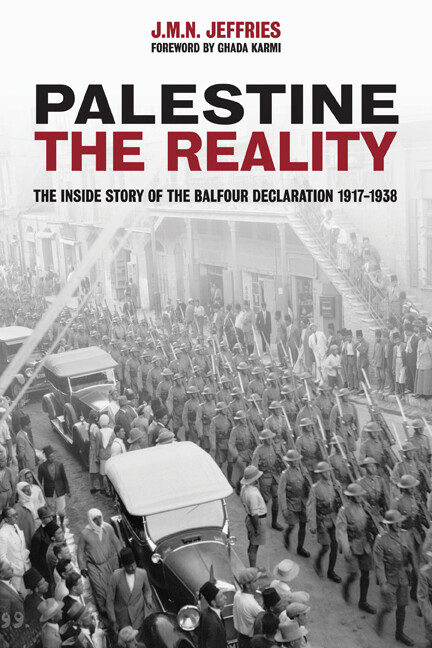
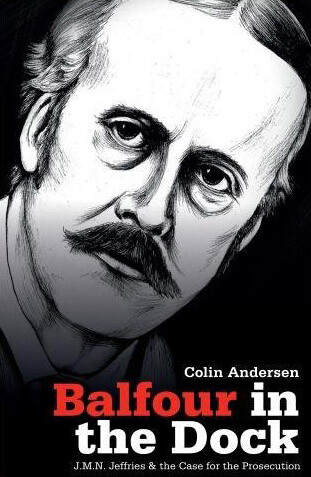
Thursday, November 2, 2017
100 Years of Balfour = 100 Years of Palestinian Dispossession
Exactly 100 years ago today the British war cabinet issued that most heinous of foreign policy documents, the Balfour Declaration. In its name, Britain unleashed wave after wave of European Zionist settlers (protected by British bayonets) on a defenceless Arab Palestine. This led inexorably to the eventual dispossession, in 1948, of Palestine's Arab inhabitants by Zionist terror gangs, bent on the creation of an exclusively Jewish, apartheid state.
The most relevant book on the subject is, of course, J.M.N. Jeffries' 1939 classic, Palestine: The Reality, thankfully reissued this year by Olive Branch Press in the US. It should be read by all serious students of the Palestine problem. Here is the summary/conclusion which follows Jeffries' forensic analysis of this appallingly racist, viciously colonial, document:
"These were its principal characteristics:
1. Its publication broke our pledged word to the Arab race.
2. Its object was to establish the Jews in a privileged position in Palestine without the assent of the population...
3. It was written in great part by those who were supposed only to have received it, and was deliberately worded so that the truth might be hidden by it, its guarantees to the Arabs be useless and its promises intangible.
4. It was ostensibly a recognition of Zionist aspirations to return to Palestine under the sanction of historic rights, but in reality it was the published clause of a private bargain by which war-spoils were to be given in payment for war-help.
"There is relief in quitting this subject... But it is a pity that it cannot be lost from sight, and a greater pity that it has not yet been removed from our public records. Unlawful in issue, arbitrary in purpose, and deceitful in wording the Balfour Declaration is the most discreditable document to which a British Government has set its hand within memory." (pp 200-01)
Readers should also know that, in London today, when the prime minister of Perfidious Albion, Theresa May, sits down to dinner with her Israeli counterpart, Benjamin Netanyahu, to celebrate 'with pride' the November 2, 1917 issue of this "most discreditable document to which a British Government has set its hand within memory," they and their entourages will be toasting 100 years of Palestinian dispossession.
The most relevant book on the subject is, of course, J.M.N. Jeffries' 1939 classic, Palestine: The Reality, thankfully reissued this year by Olive Branch Press in the US. It should be read by all serious students of the Palestine problem. Here is the summary/conclusion which follows Jeffries' forensic analysis of this appallingly racist, viciously colonial, document:
"These were its principal characteristics:
1. Its publication broke our pledged word to the Arab race.
2. Its object was to establish the Jews in a privileged position in Palestine without the assent of the population...
3. It was written in great part by those who were supposed only to have received it, and was deliberately worded so that the truth might be hidden by it, its guarantees to the Arabs be useless and its promises intangible.
4. It was ostensibly a recognition of Zionist aspirations to return to Palestine under the sanction of historic rights, but in reality it was the published clause of a private bargain by which war-spoils were to be given in payment for war-help.
"There is relief in quitting this subject... But it is a pity that it cannot be lost from sight, and a greater pity that it has not yet been removed from our public records. Unlawful in issue, arbitrary in purpose, and deceitful in wording the Balfour Declaration is the most discreditable document to which a British Government has set its hand within memory." (pp 200-01)
Readers should also know that, in London today, when the prime minister of Perfidious Albion, Theresa May, sits down to dinner with her Israeli counterpart, Benjamin Netanyahu, to celebrate 'with pride' the November 2, 1917 issue of this "most discreditable document to which a British Government has set its hand within memory," they and their entourages will be toasting 100 years of Palestinian dispossession.
Tuesday, October 29, 2013
The Unpalatable Truth About Martha Gellhorn 6
"I know now that there are things for which I am prepared to die. I am willing to die for political freedom; for the right to give my loyalty to ideals above a nation and above a class; for the right to teach my child what I think to be the truth; for the right to explore such knowledge as my brains can penetrate; for the right to love where my mind and heart admire, without reference to some dictator's code to tell me what the national canons on the matter are; for the right to work with others of like mind; for a society that seems to me becoming to the dignity of the human race."
Dorothy Thompson, 1937
"What then should we be? That each will answer for himself. But for myself I say: Though stripped of every armor, be a warrior - a warrior of the spirit, for what the spirit knows."
Dorothy Thompson, 1955
***
And so to my concluding post on this subject. I began with the question: Isn't it time to rename The Martha Gellhorn Prize for Journalism? Needless to say, I believe it is.
Also needless to say, I base my case on the fact that Martha Gellhorn failed, and miserably so, the pre-eminent litmus test for journalistic integrity in our time, namely, Palestine or Israel - which side are you on?
So what to call it then? Keeping in mind that the prize is awarded to "journalists whose work has penetrated the established version of events and told an unpalatable truth," I'd be inclined to name it (if not after my all-time favourite choice, J.M.N. Jeffries) after the great American journalist Dorothy Thompson (1893-1961).
Dorothy who? I hear you all chorus. Unfortunately, for most of us today, Dorothy Thompson's is a long forgotten name. That wasn't the case, however, in her heyday. For a background sketch, try this from the dust jacket of Peter Kurth's invaluable 1990 biography, American Cassandra: The Life of Dorothy Thompson:
"For 3 decades, amid the sweeping events of the first half of the twentieth century, no journalist was more controversial, more opinionated, more irreverent, or more quoted than Dorothy Thompson. At the pinnacle of her career, Thompson's thrice-weekly news column, 'On the Record' - one of the longest running news columns ever - reached millions of people around the globe. She was heard by millions more in her regular radio broadcasts. She was satirized by Katharine Hepburn and Spencer Tracy in Woman of the Year, and in 1939, in a Time magazine cover story, was called the most influential woman in America next to Eleanor Roosevelt."
For most of her life, Dorothy Thompson was, in fact, an uncritical supporter of the Zionist movement, largely because, like so many other Western intellectuals of the time, she was focused more on the struggle against fascism in Europe, including the appalling resurgence of state-sponsored anti-Semitism under the Nazis in pre-war Germany, than on the crimes of British imperialism in faraway Palestine or elsewhere.
Writes Peter Kurth:
"[S]he had been, up through the end of World War II, one of Zionism's most profoundly moving spokesmen. In May of 1942 she had appeared as a keynote speaker at the Biltmore Hotel in New York, where an international conference had been called to agitate for unrestricted Jewish immigration to Palestine. There is no question that Dorothy, up to that point, was wholeheartedly sympathetic to the Zionist movement and convinced (as later she was not) that the Jews were 'a separate people'... that needed to be dealt with as such after twenty centuries of persecution and oppression. 'The whole anti-Semitic movement is full of fetish and black magic,' Dorothy had written in 1943. 'It is a kind of modern witchcraft. Back of this black magic is the fact that the Jews do lead an abnormal life. They are a cohesive people without a place on earth of their own. That fact gives them, in the superstitious mind, an atmosphere of doom. An atmosphere of doom produces an atmosphere of fear.' And a state of their own, 'built by themselves and expressing their own peculiar culture and way of life,' might liberate the Jews from their status as outsiders. It would end the 'ghost story' of the Diaspora. It would allow any Jew, anywhere in the world, to make a choice: to become a member of the Jewish state, or to surrender his Jewishness (as distinct from his religious practice) once and for all to the country of his birth.
"Indeed, it was with an eye to the assimilation of the Jews that Dorothy had first thrown her support behind political Zionism. She had been assured 'time and again' (and for the first time in London, in 1920, during the Zionist conference that launched her career) that the Jewish state in Palestine would encompass 'in equal partnership' the indigenous population of the region, and that 'actively dissident Arabs,' if there were any, could be transferred 'to other parts of the vast Pan-Arab Empire, which covers a territory as large as large as the United States.' Ignorant of Arab culture, badly informed about the history of the Middle East, Dorothy had not then imagined that a Palestinian shepherd would care very much whether he drew water from a well in Bethlehem or in Fez. Later she would deeply regret the cultural and racial prejudice that had allowed her to regard 'the Arabs' as interchangeable bodies, indistinguishable one from another and superfluous in the face of Western plans, but even at the height of her devotion to Zionism she never suspected that whole populations (nearly a million people, by most estimates) would be uprooted from their homes in Palestine and driven into exile.
"'I should be opposed to it if I were a Jew,' Dorothy had warned, 'with the undimmed memory of the dispersion of my own people in mind. I should not want any Arab to sit beside the waters of Babylon and weep because he remembered Zion.' Her first trip to Palestine in 1945 had convinced her that Zionism was not the 'liberal crusade' she had thought it to be, 'that the Zionist leaders envisaged,' as she put it, 'not a small state of Jews who chose to live in Israel, but a Zionist state destined to become the leading power in the Middle East, as the ward of world Jewry whatever their citizenship in other countries [might be].' Dorothy was very much upset by Jewish terrorism in the quest for statehood. She was 'shocked beyond measure' when Menachem Begin, one of the leaders of the Irgun group that was responsible for the massacre of more than 250 Arabs at Deir Yassin, was accorded a hero's welcome by the Jews of New York, and when Ben Hecht, Peter Bergson, and other leading Zionists 'put on a show in Madison Square Garden' and 'slandered Great Britain' by displaying the Union Jack topped with the Nazi swastika. The failure of Israel, after 1948, to agree to the fixing of its borders, to heed the call for the internationalization of Jerusalem, or to provide any relief or compensation for the Palestinian refugees led Dorothy to conclude that Zionism was 'an aggressive, chauvinistic movement' and that the State of Israel was 'an expansionist power' - 'a creation of the United Nations decision made against the opposition of the whole Arab and Moslem world.'
"Ultimately Dorothy was more worried about the effect of Israeli propaganda on American foreign policy than she was about the righteousness or iniquity of Israel itself... She was ahead of most of her colleagues in journalism in considering the problem of Israel at all (beyond merely hailing its creation as a humanitarian enterprise or, like Walter Lippmann, arguing that the Western allies ought to 'impose peace' on the Middle East through the establishment of a joint Israeli-Palestinian confederation). But just as Dorothy was one of the first - and only - American journalists to speak out in defense of the Arab nations, so was she the first and most prominent American journalist to be smeared with the label of 'anti-semite'." (pp 423-425)
I'll finish specifically on the issue of the Palestinian Arab refugees of 1948, the ones so venomously slandered by Gellhorn. As it happens, the first ever documentary film in English on the subject of those refugees, Sands of Sorrow (1950), produced by the Council for Relief of Palestine Arab Refugees, was introduced and closed by Dorothy Thompson. Here is her moving introduction:
"I'm Dorothy Thompson and I have been asked to introduce Sands of Sorrow because I've recently returned from visiting the scenes of the picture you are about to see. Of course, the impression left on my mind by these wretched casualties of political change is much more distressing than the film. For no film can convey the icy winds from Mt Hermon as they blow upon flimsy, floorless tents in Syria or the rains that turn dwellings into mud holes in the rainy season in Lebanon. Nor the defeated feeling even of those who are trying to help, but this film tells part of the story that, until now, has hardly been told at all outside the Arab world."
This is light years away from the propagandist bile of Martha Gellhorn.
Re the name change, I rest my case.
Dorothy Thompson, 1937
"What then should we be? That each will answer for himself. But for myself I say: Though stripped of every armor, be a warrior - a warrior of the spirit, for what the spirit knows."
Dorothy Thompson, 1955
***
And so to my concluding post on this subject. I began with the question: Isn't it time to rename The Martha Gellhorn Prize for Journalism? Needless to say, I believe it is.
Also needless to say, I base my case on the fact that Martha Gellhorn failed, and miserably so, the pre-eminent litmus test for journalistic integrity in our time, namely, Palestine or Israel - which side are you on?
So what to call it then? Keeping in mind that the prize is awarded to "journalists whose work has penetrated the established version of events and told an unpalatable truth," I'd be inclined to name it (if not after my all-time favourite choice, J.M.N. Jeffries) after the great American journalist Dorothy Thompson (1893-1961).
Dorothy who? I hear you all chorus. Unfortunately, for most of us today, Dorothy Thompson's is a long forgotten name. That wasn't the case, however, in her heyday. For a background sketch, try this from the dust jacket of Peter Kurth's invaluable 1990 biography, American Cassandra: The Life of Dorothy Thompson:
"For 3 decades, amid the sweeping events of the first half of the twentieth century, no journalist was more controversial, more opinionated, more irreverent, or more quoted than Dorothy Thompson. At the pinnacle of her career, Thompson's thrice-weekly news column, 'On the Record' - one of the longest running news columns ever - reached millions of people around the globe. She was heard by millions more in her regular radio broadcasts. She was satirized by Katharine Hepburn and Spencer Tracy in Woman of the Year, and in 1939, in a Time magazine cover story, was called the most influential woman in America next to Eleanor Roosevelt."
For most of her life, Dorothy Thompson was, in fact, an uncritical supporter of the Zionist movement, largely because, like so many other Western intellectuals of the time, she was focused more on the struggle against fascism in Europe, including the appalling resurgence of state-sponsored anti-Semitism under the Nazis in pre-war Germany, than on the crimes of British imperialism in faraway Palestine or elsewhere.
Writes Peter Kurth:
"[S]he had been, up through the end of World War II, one of Zionism's most profoundly moving spokesmen. In May of 1942 she had appeared as a keynote speaker at the Biltmore Hotel in New York, where an international conference had been called to agitate for unrestricted Jewish immigration to Palestine. There is no question that Dorothy, up to that point, was wholeheartedly sympathetic to the Zionist movement and convinced (as later she was not) that the Jews were 'a separate people'... that needed to be dealt with as such after twenty centuries of persecution and oppression. 'The whole anti-Semitic movement is full of fetish and black magic,' Dorothy had written in 1943. 'It is a kind of modern witchcraft. Back of this black magic is the fact that the Jews do lead an abnormal life. They are a cohesive people without a place on earth of their own. That fact gives them, in the superstitious mind, an atmosphere of doom. An atmosphere of doom produces an atmosphere of fear.' And a state of their own, 'built by themselves and expressing their own peculiar culture and way of life,' might liberate the Jews from their status as outsiders. It would end the 'ghost story' of the Diaspora. It would allow any Jew, anywhere in the world, to make a choice: to become a member of the Jewish state, or to surrender his Jewishness (as distinct from his religious practice) once and for all to the country of his birth.
"Indeed, it was with an eye to the assimilation of the Jews that Dorothy had first thrown her support behind political Zionism. She had been assured 'time and again' (and for the first time in London, in 1920, during the Zionist conference that launched her career) that the Jewish state in Palestine would encompass 'in equal partnership' the indigenous population of the region, and that 'actively dissident Arabs,' if there were any, could be transferred 'to other parts of the vast Pan-Arab Empire, which covers a territory as large as large as the United States.' Ignorant of Arab culture, badly informed about the history of the Middle East, Dorothy had not then imagined that a Palestinian shepherd would care very much whether he drew water from a well in Bethlehem or in Fez. Later she would deeply regret the cultural and racial prejudice that had allowed her to regard 'the Arabs' as interchangeable bodies, indistinguishable one from another and superfluous in the face of Western plans, but even at the height of her devotion to Zionism she never suspected that whole populations (nearly a million people, by most estimates) would be uprooted from their homes in Palestine and driven into exile.
"'I should be opposed to it if I were a Jew,' Dorothy had warned, 'with the undimmed memory of the dispersion of my own people in mind. I should not want any Arab to sit beside the waters of Babylon and weep because he remembered Zion.' Her first trip to Palestine in 1945 had convinced her that Zionism was not the 'liberal crusade' she had thought it to be, 'that the Zionist leaders envisaged,' as she put it, 'not a small state of Jews who chose to live in Israel, but a Zionist state destined to become the leading power in the Middle East, as the ward of world Jewry whatever their citizenship in other countries [might be].' Dorothy was very much upset by Jewish terrorism in the quest for statehood. She was 'shocked beyond measure' when Menachem Begin, one of the leaders of the Irgun group that was responsible for the massacre of more than 250 Arabs at Deir Yassin, was accorded a hero's welcome by the Jews of New York, and when Ben Hecht, Peter Bergson, and other leading Zionists 'put on a show in Madison Square Garden' and 'slandered Great Britain' by displaying the Union Jack topped with the Nazi swastika. The failure of Israel, after 1948, to agree to the fixing of its borders, to heed the call for the internationalization of Jerusalem, or to provide any relief or compensation for the Palestinian refugees led Dorothy to conclude that Zionism was 'an aggressive, chauvinistic movement' and that the State of Israel was 'an expansionist power' - 'a creation of the United Nations decision made against the opposition of the whole Arab and Moslem world.'
"Ultimately Dorothy was more worried about the effect of Israeli propaganda on American foreign policy than she was about the righteousness or iniquity of Israel itself... She was ahead of most of her colleagues in journalism in considering the problem of Israel at all (beyond merely hailing its creation as a humanitarian enterprise or, like Walter Lippmann, arguing that the Western allies ought to 'impose peace' on the Middle East through the establishment of a joint Israeli-Palestinian confederation). But just as Dorothy was one of the first - and only - American journalists to speak out in defense of the Arab nations, so was she the first and most prominent American journalist to be smeared with the label of 'anti-semite'." (pp 423-425)
I'll finish specifically on the issue of the Palestinian Arab refugees of 1948, the ones so venomously slandered by Gellhorn. As it happens, the first ever documentary film in English on the subject of those refugees, Sands of Sorrow (1950), produced by the Council for Relief of Palestine Arab Refugees, was introduced and closed by Dorothy Thompson. Here is her moving introduction:
"I'm Dorothy Thompson and I have been asked to introduce Sands of Sorrow because I've recently returned from visiting the scenes of the picture you are about to see. Of course, the impression left on my mind by these wretched casualties of political change is much more distressing than the film. For no film can convey the icy winds from Mt Hermon as they blow upon flimsy, floorless tents in Syria or the rains that turn dwellings into mud holes in the rainy season in Lebanon. Nor the defeated feeling even of those who are trying to help, but this film tells part of the story that, until now, has hardly been told at all outside the Arab world."
This is light years away from the propagandist bile of Martha Gellhorn.
Re the name change, I rest my case.
Sunday, September 8, 2013
The Morning After
Feeling a bit queasy this morning?
Now you know how a Palestinian Arab must have felt as he opened his newspaper of November 4, 1917 and read the following: "His Majesty's Government view with favour the establishment in Palestine of a national home for the Jewish people, and will use their best endeavours to facilitate the achievement of this object, it being clearly understood that nothing shall be done which may prejudice the civil and religious rights of existing non-Jewish communities in Palestine..."
That, of course, is the (black) heart of Lord Balfour's infamous Declaration of November 2, 1917.
In fact, the Balfour Declaration was kept secret from those "existing non-Jewish communities in Palestine" - that is, the Palestinian Arabs who comprised around 93% of Palestine's population at the time - for the duration of General Allenby's campaign against the Turks. The context and circumstances of its suppression (although copies were showered by British planes over those cities in Eastern Europe and Russia with large Jewish populations) are worth recalling:
"A plan had been drawn up between Allenby and Lawrence, who had already discussed it with Feisal, by which the Arabs were to advance from Akaba when railway communications had advanced enough to ensure supplies and if possible to arrive at the Jordan before the end of March [1918]. In a raid they burned the lighters and launches of the Turks and stopped water-traffic on the Dead Sea before January was over... But as the spring advanced the possibility of carrying out the advance into northern Palestine and to Damascus faded away. Troops were taken from Allenby... for the Western Front, then endangered by a German offensive. On the 5th of May Allenby told Lawrence the Arabs would just have to hold on for the present.
"He softened this blow by allotting to them two thousand riding camels which the dissolution of a Sinai force had put at his disposal. This was the chief of a number of allocations of personnel, material and stores to his Arab right, to which he now gave considerable trust. To the Arab political cause Allenby made a species of gift too, a negative one perhaps but having its value. He would not have the Balfour Declaration published in Palestine.
"Arabs in official positions, those who read British newspapers, and others such got to know of it, of course, and as far as they could, began at once to attack it. But from the mass of the people it was kept hid, though there was Zionist complaint of this. 'No official instruction seems to have been given by Whitehall in London to General Headquarters in Cairo as to bringing their action into accord with the new idealist character which the Palestine offensive, in view of the Balfour Declaration, had acquired.' (Zionist Official Report.) The new idealist character! A pleasant concept, this, of Allenby and his mundane army being regenerated by the Balfour Declaration.
"Mr. Graves* suggests that the Declaration was not published (it was only proclaimed in Palestine after two years had passed) because 'when the result of the War was in grave doubt it was not a fitting moment to make any official proclamation of our intentions as regards hostile territory.' What of the Balfour Declaration then? For whom too was a proclamation not fitting? For the enemy? The enemy had spread it about the world as widely as the enemy's wireless-service permitted. For the nations of Europe? For India? For the American continent? They all knew it from universal publication in the Press.
"The only people who could be, and were ignorant of the Declaration were the inhabitants of Palestine and the adjacent war-zones, who probably had not ten wireless-sets between them nor any access to newspapers. So that Mr. Graves unintentionally leads us to the chief reason why the Declaration was not published, which, as it happens, the Zionists themselves have confessed. As they put it, 'There can be no doubt but that General Allenby knew by the time that such a Declaration had been issued. But the military authorities obviously thought that any official mention of that fact in the newly conquered territory might mar the jubilation of certain sections of the population. Naturally anxious to avoid any friction which might hinder the freedom of further military operations, they preferred to abstain from any mention of the fact that the British Government had promised to support Zionist aspirations.' (Zionist Official Report.)
"There is one part of the truth expressed with some marvellous phraseology. In plain English, the Government had issued a Declaration so high-handed, so improper that it would have been a danger to the progress of the army. It had to be suppressed.
"The general evidence points to Allenby having suppressed it himself. There is reason to believe too that while he felt that publication of it would have injured his campaign, there was a stronger reason still for his action. He did not think it was legitimate for him to publish it, because it contravened the Hague Convention to which Great Britain had subscribed. Under the Hague Convention an occupying power must not introduce a new political regime.
"However that be, the non-publication of the Declaration introduces an inescapable dilemma. If Allenby suppressed it himself, the Government had to be censored by its own forces in the field. If it was suppressed by order or agreement of the Government then the Government knew the Declaration was a betrayal of the Arabs, and preferred to conceal it from them till their country was in the Government's control." (Palestine: The Reality, JMN Jeffries, 1939, pp 217-219)
Hm... I wonder what high-handed, improper declarations Abbott's been sitting on until now.
[*Philip Graves: Palestine, the land of three faiths (1923)]
Now you know how a Palestinian Arab must have felt as he opened his newspaper of November 4, 1917 and read the following: "His Majesty's Government view with favour the establishment in Palestine of a national home for the Jewish people, and will use their best endeavours to facilitate the achievement of this object, it being clearly understood that nothing shall be done which may prejudice the civil and religious rights of existing non-Jewish communities in Palestine..."
That, of course, is the (black) heart of Lord Balfour's infamous Declaration of November 2, 1917.
In fact, the Balfour Declaration was kept secret from those "existing non-Jewish communities in Palestine" - that is, the Palestinian Arabs who comprised around 93% of Palestine's population at the time - for the duration of General Allenby's campaign against the Turks. The context and circumstances of its suppression (although copies were showered by British planes over those cities in Eastern Europe and Russia with large Jewish populations) are worth recalling:
"A plan had been drawn up between Allenby and Lawrence, who had already discussed it with Feisal, by which the Arabs were to advance from Akaba when railway communications had advanced enough to ensure supplies and if possible to arrive at the Jordan before the end of March [1918]. In a raid they burned the lighters and launches of the Turks and stopped water-traffic on the Dead Sea before January was over... But as the spring advanced the possibility of carrying out the advance into northern Palestine and to Damascus faded away. Troops were taken from Allenby... for the Western Front, then endangered by a German offensive. On the 5th of May Allenby told Lawrence the Arabs would just have to hold on for the present.
"He softened this blow by allotting to them two thousand riding camels which the dissolution of a Sinai force had put at his disposal. This was the chief of a number of allocations of personnel, material and stores to his Arab right, to which he now gave considerable trust. To the Arab political cause Allenby made a species of gift too, a negative one perhaps but having its value. He would not have the Balfour Declaration published in Palestine.
"Arabs in official positions, those who read British newspapers, and others such got to know of it, of course, and as far as they could, began at once to attack it. But from the mass of the people it was kept hid, though there was Zionist complaint of this. 'No official instruction seems to have been given by Whitehall in London to General Headquarters in Cairo as to bringing their action into accord with the new idealist character which the Palestine offensive, in view of the Balfour Declaration, had acquired.' (Zionist Official Report.) The new idealist character! A pleasant concept, this, of Allenby and his mundane army being regenerated by the Balfour Declaration.
"Mr. Graves* suggests that the Declaration was not published (it was only proclaimed in Palestine after two years had passed) because 'when the result of the War was in grave doubt it was not a fitting moment to make any official proclamation of our intentions as regards hostile territory.' What of the Balfour Declaration then? For whom too was a proclamation not fitting? For the enemy? The enemy had spread it about the world as widely as the enemy's wireless-service permitted. For the nations of Europe? For India? For the American continent? They all knew it from universal publication in the Press.
"The only people who could be, and were ignorant of the Declaration were the inhabitants of Palestine and the adjacent war-zones, who probably had not ten wireless-sets between them nor any access to newspapers. So that Mr. Graves unintentionally leads us to the chief reason why the Declaration was not published, which, as it happens, the Zionists themselves have confessed. As they put it, 'There can be no doubt but that General Allenby knew by the time that such a Declaration had been issued. But the military authorities obviously thought that any official mention of that fact in the newly conquered territory might mar the jubilation of certain sections of the population. Naturally anxious to avoid any friction which might hinder the freedom of further military operations, they preferred to abstain from any mention of the fact that the British Government had promised to support Zionist aspirations.' (Zionist Official Report.)
"There is one part of the truth expressed with some marvellous phraseology. In plain English, the Government had issued a Declaration so high-handed, so improper that it would have been a danger to the progress of the army. It had to be suppressed.
"The general evidence points to Allenby having suppressed it himself. There is reason to believe too that while he felt that publication of it would have injured his campaign, there was a stronger reason still for his action. He did not think it was legitimate for him to publish it, because it contravened the Hague Convention to which Great Britain had subscribed. Under the Hague Convention an occupying power must not introduce a new political regime.
"However that be, the non-publication of the Declaration introduces an inescapable dilemma. If Allenby suppressed it himself, the Government had to be censored by its own forces in the field. If it was suppressed by order or agreement of the Government then the Government knew the Declaration was a betrayal of the Arabs, and preferred to conceal it from them till their country was in the Government's control." (Palestine: The Reality, JMN Jeffries, 1939, pp 217-219)
Hm... I wonder what high-handed, improper declarations Abbott's been sitting on until now.
[*Philip Graves: Palestine, the land of three faiths (1923)]
Wednesday, July 24, 2013
Most Definitely a Shaw Thing
Further to my July 11 discussion of George Bernard Shaw (1856-1950) and his attitude toward Islam, it's interesting to recall just what the renowned, left-leaning, Irish playwright and essayist had to say about Zionism.
Zionism, it should be said, was hardly uppermost in Shaw's mind, and insofar as he touched on it, it is reasonable to assume that he shared the British Left's purblind tendency to see British imperialism rather than the ruthless, manipulative, ethno-nationalism of the Zionist movement as the main player in Palestine.* Nevertheless, as an Irishman, he knew a colonial clusterfuck when he saw one coming.
Shaw's take on the Zionist project in Palestine emerges most strongly in a short, untitled, satirical sketch he wrote on the origins of Britain's fateful 1917 Balfour Declaration, which infamously promised to "view with favour the establishment in Palestine of a national home for the Jewish people."
It came in the context of a correspondence with British socialist and Independent Labour Party MP Fenner Brockway, most probably, although this is not specified, in the late thirties. As Brockway explains in his memoir Outside the Right:
"I had a startling reply to a request for an opinion on a policy statement on Palestine which I had written for the I.L.P. 'This is all nonsense, the historical part,' he rebuked, adding he could only comment adequately in the form of a 3-act play. He enclosed it and granted me the right to publish. The theme was that Arthur Balfour gave Dr Weitzmann Palestine in return for a chemical device for killing Germans. I reproduce the play at the end of this chapter." (1963, p 87)
Referred to by Brockway as Shaw's "lost play," the playwright's skewering of the insufferable Lord Arthur James Balfour is deliciously Yes Minister:
ACT I
1917. Scene: The Foreign Secretary's room at the Foreign Office. Arthur is contemplating with dismay a document which has been handed to him by an attache.
Arthur: Boy, this is awful. Are you sure your figures are correct?
Attache: They have been checked 3 times over, sir.
Arthur: This is really what the war is costing us?
Attache: Under the mark, if anything, sir.
Arthur: Young man, do you realize - but no. Only a Scot can feel as I feel about it. Look at this one item alone. Five thousand and thirty-eight pounds, 15 shillings and 9 & 7/8 pence for cordite enough to kill a single German. How can any country stand such a strain?
Attache: It's not the cordite, sir. It's the acetone [**] that is so expensive. Cordite cannot be made without acetone.
Arthur: I don't know what acetone is; and I don't care. All I know is that if we go on like this we shall have to give an order to cease killing Germans. Dead Germans cost too much... Are our chemists trying how to find something cheaper?
Attache: They are doing their best; but nothing has come of it so far. There's a chemist in Manchester who has a microbe that makes acetone for next to nothing.
Arthur: Send him here instantly. Why hasn't he been sent here before?
Attache: Impossible, sir, unfortunately.
Arthur: Nothing is impossible when we are at war. Why is it impossible?
Attache: He is a Jew, sir.
Arthur: Is his microbe a Jew?
Attache: I suppose not, sir.
Arthur: Is Sir Herbert Samuel a Jew or is he not? Is he in the Cabinet or is he not?
Attache: But it is a coalition Government, sir. All sorts of people are let in.
Arthur: Any other objection?
Attache: Well, Manchester, you know, sir. Provincial. And Owens College! If it were Cambridge, now, we might stretch a point.
Arthur: If this Jewish gentleman is not in this room in 3 hours, you go to the trenches.
Attache: Oh, if you make a point of it, of course. But we shall lose tone.
Arthur (roaring): Get out!
(The attache shrugs his shoulders and goes out.)
Arthur (clutching his temples as he again pores over the sheet of figures): Five thousand and thirty-eight golden pounds to put one Boche out of action! And we have to exterminate the lot of them!
ACT II
(As before, 3 hours later, but with Dr Chaim Weizmann instead of the attache.)
Arthur: Doctor Weizmann, we must have that microbe at your own price. Name it. We shall not hesitate at 6 figures.
Dr Weizmann: I do not ask for money.
Arthur: There must be some misunderstanding. I was informed that you are a Jew.
Weizmann: You were informed correctly. I am a Jew.
Arthur: But - pardon me - you said you did not ask for money.
Wiezmann: Precisely, I do not want money.
Arthur: A title, perhaps? Baron? Viscount? Do not hesitate.
Wiezmann: Nothing would induce me to accept a title. I should have to pay more for everything.
Arthur: Then may I ask, without offence, since you want none of the things that everybody wants, what the devil do you want?
Weizmann: I want Jerusalem.
Arthur: It's yours. I only regret that we cannot throw in Madagascar as well. Unfortunately it belongs to the French Government. The Holy Land belongs naturally to the Church of England and to it you are most welcome. And now will you be so good as to hand over the microbe.
ACT III
Mr Bernard Shaw in his sumptuously furnished study reading the announcement of the Balfour Declaration.
MR B. S.: Another Ulster! As if one were not enough.
CURTAIN
[*For the full story here, see my April 2012 serialisation of J.M.N. Jeffries's Palestine: The Reality, Chapter 11: The Balfour Deception 1-7; **For this particular strand of the story, see my 11/11/12 post Palestine on a Platter.]
Zionism, it should be said, was hardly uppermost in Shaw's mind, and insofar as he touched on it, it is reasonable to assume that he shared the British Left's purblind tendency to see British imperialism rather than the ruthless, manipulative, ethno-nationalism of the Zionist movement as the main player in Palestine.* Nevertheless, as an Irishman, he knew a colonial clusterfuck when he saw one coming.
Shaw's take on the Zionist project in Palestine emerges most strongly in a short, untitled, satirical sketch he wrote on the origins of Britain's fateful 1917 Balfour Declaration, which infamously promised to "view with favour the establishment in Palestine of a national home for the Jewish people."
It came in the context of a correspondence with British socialist and Independent Labour Party MP Fenner Brockway, most probably, although this is not specified, in the late thirties. As Brockway explains in his memoir Outside the Right:
"I had a startling reply to a request for an opinion on a policy statement on Palestine which I had written for the I.L.P. 'This is all nonsense, the historical part,' he rebuked, adding he could only comment adequately in the form of a 3-act play. He enclosed it and granted me the right to publish. The theme was that Arthur Balfour gave Dr Weitzmann Palestine in return for a chemical device for killing Germans. I reproduce the play at the end of this chapter." (1963, p 87)
Referred to by Brockway as Shaw's "lost play," the playwright's skewering of the insufferable Lord Arthur James Balfour is deliciously Yes Minister:
ACT I
1917. Scene: The Foreign Secretary's room at the Foreign Office. Arthur is contemplating with dismay a document which has been handed to him by an attache.
Arthur: Boy, this is awful. Are you sure your figures are correct?
Attache: They have been checked 3 times over, sir.
Arthur: This is really what the war is costing us?
Attache: Under the mark, if anything, sir.
Arthur: Young man, do you realize - but no. Only a Scot can feel as I feel about it. Look at this one item alone. Five thousand and thirty-eight pounds, 15 shillings and 9 & 7/8 pence for cordite enough to kill a single German. How can any country stand such a strain?
Attache: It's not the cordite, sir. It's the acetone [**] that is so expensive. Cordite cannot be made without acetone.
Arthur: I don't know what acetone is; and I don't care. All I know is that if we go on like this we shall have to give an order to cease killing Germans. Dead Germans cost too much... Are our chemists trying how to find something cheaper?
Attache: They are doing their best; but nothing has come of it so far. There's a chemist in Manchester who has a microbe that makes acetone for next to nothing.
Arthur: Send him here instantly. Why hasn't he been sent here before?
Attache: Impossible, sir, unfortunately.
Arthur: Nothing is impossible when we are at war. Why is it impossible?
Attache: He is a Jew, sir.
Arthur: Is his microbe a Jew?
Attache: I suppose not, sir.
Arthur: Is Sir Herbert Samuel a Jew or is he not? Is he in the Cabinet or is he not?
Attache: But it is a coalition Government, sir. All sorts of people are let in.
Arthur: Any other objection?
Attache: Well, Manchester, you know, sir. Provincial. And Owens College! If it were Cambridge, now, we might stretch a point.
Arthur: If this Jewish gentleman is not in this room in 3 hours, you go to the trenches.
Attache: Oh, if you make a point of it, of course. But we shall lose tone.
Arthur (roaring): Get out!
(The attache shrugs his shoulders and goes out.)
Arthur (clutching his temples as he again pores over the sheet of figures): Five thousand and thirty-eight golden pounds to put one Boche out of action! And we have to exterminate the lot of them!
ACT II
(As before, 3 hours later, but with Dr Chaim Weizmann instead of the attache.)
Arthur: Doctor Weizmann, we must have that microbe at your own price. Name it. We shall not hesitate at 6 figures.
Dr Weizmann: I do not ask for money.
Arthur: There must be some misunderstanding. I was informed that you are a Jew.
Weizmann: You were informed correctly. I am a Jew.
Arthur: But - pardon me - you said you did not ask for money.
Wiezmann: Precisely, I do not want money.
Arthur: A title, perhaps? Baron? Viscount? Do not hesitate.
Wiezmann: Nothing would induce me to accept a title. I should have to pay more for everything.
Arthur: Then may I ask, without offence, since you want none of the things that everybody wants, what the devil do you want?
Weizmann: I want Jerusalem.
Arthur: It's yours. I only regret that we cannot throw in Madagascar as well. Unfortunately it belongs to the French Government. The Holy Land belongs naturally to the Church of England and to it you are most welcome. And now will you be so good as to hand over the microbe.
ACT III
Mr Bernard Shaw in his sumptuously furnished study reading the announcement of the Balfour Declaration.
MR B. S.: Another Ulster! As if one were not enough.
CURTAIN
[*For the full story here, see my April 2012 serialisation of J.M.N. Jeffries's Palestine: The Reality, Chapter 11: The Balfour Deception 1-7; **For this particular strand of the story, see my 11/11/12 post Palestine on a Platter.]
Sunday, May 12, 2013
Israel: The Movie?
Every settler-colonial state has its epic tale in which the heroic White Man faces and beats back an onslaught by fanatical black, brown, red or yellow hordes. To cite but two examples of the genre, the Britz have their Battle of Rorke's Drift against the Zulus in 1879, and the Yanks their Battle of Killdeer Mountain against the Sioux in 1864.
But what about that Johnny-Come-Lately to sticking it to the natives, Israel? Not to be outdone, Israelis have their Battle of Hanita against the Bedouin hordes in 1938.
Now you've probably never heard of it, and that's because, when it came to Zionist heroics in 30s Palestine, reputable chroniclers of the time could be such party poopers.
Take J.M.N. Jeffries, for example. Clearly, he just didn't get it:
"The Zionist movement to obtain Galilee had been launched in the spring in London with every circumstance of importance. Dr Weizmann and other chiefs of the Zionist Executive started the campaign with an appeal to the Zionists of the world to support an 'On to Galilee' fund. 'Hitherto,' it said, 'the north has benefited only meagrely from the boon of Jewish creative effort.'
"But now strategic reasons involved a campaign for what was called 'the redemption of Galilee' and produced a sudden re-evocation of Galilee's Jewish connections in the past. These strategic reasons were not concealed in the literature of the movement. 'Safeguard the frontiers of Palestine,' said a typical slogan amidst the announcements of the new drive for Galilee. Zionist settlements, it was made clear, were to be set down like strong-points along the frontier, so as to establish an occupation and to justify the handing-over of the province to the Zionist State. The Zionist Press gave details of the foundation of these fort-settlements in hostile territory. At Hanuta, the first of them on the northern frontier (this was in March) 'the permanent buildings and defence stockades [my italics] at the village are rapidly being completed by the group in occupation.'
"'It is of paramount importance,' continued the Jewish Chronicle when giving this information, 'for a larger Jewish area to be established in Upper Galilee, where the Jewish agricultural community has been more or less static since the initiation of post-War colonization. The area of Jewish settlement will have to be taken into account by the authorities as a decisive factor in the formulation of any definite policy. Such colonization is also necessary from the point of view of the security of the existing Community.'
"The strategic character of Hanuta soon was endorsed by an attack upon it, in which one of its defenders was killed, and one of the assailants. Three hundred new 'settlers' were sent up to this isolated position. They would have been better described as reinforcements." (Palestine: The Reality, 1939, pp 689-690)
See what I mean about party poopers? No, what was needed was a real live Zionist party animal to tell and sell the Battle of Hanita to Mr and Mrs America.
Enter the Dutch-Canadian-American Gentile Zionist and writer, Pierre van Paassen (1895-1968). Almost forgotten now, but a best-seller* in his day, van Paassen, in his 1943 book The Forgotten Ally, turned the battle of Hanita into, well, the Battle of Hanita - know what I mean? Not quite? Well, put it this way: if you loved Leon Uris' Exodus, you're going to LOVE van Paassen's ripping good yarn.
[*My February 1946 copy is a twelfth printing.]
Next post: The Battle of Hanita 1
But what about that Johnny-Come-Lately to sticking it to the natives, Israel? Not to be outdone, Israelis have their Battle of Hanita against the Bedouin hordes in 1938.
Now you've probably never heard of it, and that's because, when it came to Zionist heroics in 30s Palestine, reputable chroniclers of the time could be such party poopers.
Take J.M.N. Jeffries, for example. Clearly, he just didn't get it:
"The Zionist movement to obtain Galilee had been launched in the spring in London with every circumstance of importance. Dr Weizmann and other chiefs of the Zionist Executive started the campaign with an appeal to the Zionists of the world to support an 'On to Galilee' fund. 'Hitherto,' it said, 'the north has benefited only meagrely from the boon of Jewish creative effort.'
"But now strategic reasons involved a campaign for what was called 'the redemption of Galilee' and produced a sudden re-evocation of Galilee's Jewish connections in the past. These strategic reasons were not concealed in the literature of the movement. 'Safeguard the frontiers of Palestine,' said a typical slogan amidst the announcements of the new drive for Galilee. Zionist settlements, it was made clear, were to be set down like strong-points along the frontier, so as to establish an occupation and to justify the handing-over of the province to the Zionist State. The Zionist Press gave details of the foundation of these fort-settlements in hostile territory. At Hanuta, the first of them on the northern frontier (this was in March) 'the permanent buildings and defence stockades [my italics] at the village are rapidly being completed by the group in occupation.'
"'It is of paramount importance,' continued the Jewish Chronicle when giving this information, 'for a larger Jewish area to be established in Upper Galilee, where the Jewish agricultural community has been more or less static since the initiation of post-War colonization. The area of Jewish settlement will have to be taken into account by the authorities as a decisive factor in the formulation of any definite policy. Such colonization is also necessary from the point of view of the security of the existing Community.'
"The strategic character of Hanuta soon was endorsed by an attack upon it, in which one of its defenders was killed, and one of the assailants. Three hundred new 'settlers' were sent up to this isolated position. They would have been better described as reinforcements." (Palestine: The Reality, 1939, pp 689-690)
See what I mean about party poopers? No, what was needed was a real live Zionist party animal to tell and sell the Battle of Hanita to Mr and Mrs America.
Enter the Dutch-Canadian-American Gentile Zionist and writer, Pierre van Paassen (1895-1968). Almost forgotten now, but a best-seller* in his day, van Paassen, in his 1943 book The Forgotten Ally, turned the battle of Hanita into, well, the Battle of Hanita - know what I mean? Not quite? Well, put it this way: if you loved Leon Uris' Exodus, you're going to LOVE van Paassen's ripping good yarn.
[*My February 1946 copy is a twelfth printing.]
Next post: The Battle of Hanita 1
Tuesday, January 8, 2013
The Jeffries-Dugdale Exchange 3
Jeffries' final riposte in the July 24, 1936 issue of The Spectator:
"SIR,-There is an Arab delegation from Palestine in London at the present moment. It is, I think, the fifth which has come to this country. Certainly it is one of a series of Arab delegations which have been spread over the years since the War and have remained in London, waiting on the Colonial Office, for periods varying from a complete twelvemonth.
"The present delegation, though concentrating on the question of Jewish immigration, is making the same demands its predecessors made. A couple of members, who belonged to previous delegations, are renewing the demands they made as much younger men. Last week a delegate said drily to me that he supposed their sons would come along in due course and repeat the pleas of their fathers to the same deaf walls. That is what I mean when I say that the Arabs have been unheard, a phrase by which Mrs Dugdale is rhetorically puzzled.
"As for their being sidetracked, all that has been said or done, by the Arabs or on their behalf, in Palestine or out of it, during nearly two decades, has achieved what in reply? A succession of essays in verbiage from Whitehall. Public outcry and official enquiries have had the same answer. First one Colonial Secretary explains what the Balfour Declaration means, not to the Arabs, but to the Jews. Then another Colonial Secretary explains the explanation. This process has been continued till now the original Balfour Declaration is in a sort of mathematical situation, a surd surrounded by brackets upon brackets of explanation.
"The final bracket very suitably was put in place by the hands of Mr Ramsay MacDonald. He excelled himself in a letter, a species of White Paper, addressed to Dr Weizmann, who seems more and more to be winning the position of a sovereign State. That document, elicited by the most recent Commission of Enquiry into Palestine's affairs, touched upon all of these and deepened the obscurity surrounding each of them. Only one thing could be inferred with any likelihood, that the recommendations of the Commission would not be carried out. This proved to be true.
"One of the persistent requests of the Arabs is that the recommendations of Commissions and of Reports appointed or instigated by British Governments should be carried out by those same Governments. It is a singular request for them to have to make. But, as Mrs Dugdale would say no doubt, this request has never been sidetracked. The faithful observance, clause by clause, of the recommendations of the Shaw Commission, the Hope Simpson report, the French report, are equally familiar to her. I say nothing of old forgotten far-off things such as the Palin findings, given so widely to the world, and the rapid implementation of Lord Passfield's act of justice.
"I write with scorn, but what other attitude is possible to anyone reviewing the behaviour of British rulers in the Holy Land? There are reasons excusing Mrs Dugdale's advocacy, but into what pitiful artifices she is led. 'The gateway to peace,' she cries, 'is not through numerical calculations.' Does she believe that by calling the process which has placed the House of Commons at the head of the British people a 'numerical calculation' she will hide its true nature? Is a man's vote a right in England and a wrong in Palestine? Is this country to profess itself in Europe as the champion of democracy and in Asia as its enemy? Are we in England to set an example to despots of elective government, and out of England an example to elective governments of despotic control?
"Pro-Zionists prate of the Mandate and of our 'obligations' under it to the world. Is there a man in the world who believes in these 'obligations,' conferred by ourselves upon ourselves and for ourselves. As an honest and admirable writer has said, the San Remo Conference at which mandates were exchanged might have been termed by a cynic the 'Inter-Allied Prize Distribution.' The only obligation at San Remo to be heard of was in the spry tones of Mr Lloyd George and the other national delegates, saying 'Much obliged' as they passed the Mandates over the table one to another. 'The utmost cordiality reigned,' says a despatch of the period, describing the scene.
"For reasons which escape me, we could not say then, nor have said since, that the retention of the adjacencies of the Suez Canal was necessary for the communications of our Empire. We could not straightforwardly proclaim there - as would have been quite proper - a Monroe doctrine of ours akin to the Americans' doctrine at Panama. Instead, under cover of a benevolent Mandate, we instal the 'National Home' violently, believing that its denizens will hold the fort for us.* We refuse the population the freedom, under our guidance, which we had sworn to give them. We confer on Arabs noms-de-plume like 'Palestinian' and proffer them safeguards which we are careful not to define. The tribes which cheered Allenby are fined by his successors, and ten battalions of British troops are in arms against a few devoted wretches where eighteen years ago a single infantryman could have garrisoned a town.
"What is to be said of a policy which has brought us to this?-I am, Sir, yours faithfully, J.M.N. JEFFRIES. Easthayes, Cullompton, Devon."
[*Jeffries is perhaps recalling Sir Ronald Storr's famous line about "the [Zionist] enterprise... forming for England 'a little loyal Jewish Ulster' in a sea of potentially hostile Arabism."]
Jeffries' letter is nothing less than magnificent, such that only a Zionist deadender like 'Baffy' could possibly be immune to its powers of persuasion. Her response of July 31, in particular her second paragraph, with its pious folderol about Arab-Jewish "fellowship", is as fine an example of flying in the face of reality as you could possibly hope for. What a fool for Zion the woman was! Little wonder that Jeffries didn't bother dignify it with a reply:
"SIR,-I hate to confess myself beaten, but the effort to bring Mr Jeffries' version of British rule in Palestine into line with facts is becoming too great by comparison with the results attained.
"I do not understand what he means when he says that the British Government's successive White Papers have been 'addressed not to the Arabs but to the Jews.' These statements of policy are accessible to us all, and I would suggest that Mr Jeffries should study the first of them, issued in 1922, and compare it with the text of the Mandate for Palestine and Transjordan. He will find that the White Paper restricts the area of the Jewish National Home to Palestine itself, whereas no such limitation is implicit in the Mandate. The reason for this very severe curtailment of Jewish settlement was that Transjordan lies within the boundaries of the territories where certain promises about Arab independence were made by the British Government to King Hussein. (See Survey of International Affairs, 1925, Vol. I, p. 361, published by the Royal Institute of International Affairs.) Mr Jeffries dismisses all the White Papers as 'essays in verbiage.' It is a point on which he can claim to speak with authority, but it would be interesting to know whether this clause appears to him as redundant as the others. If it does not, then let him remember it next time he spills the vials of his wrath upon the British Government on the score of its alleged indifference to Arab rights.
"Some of the 'scorn' with which he views British policy has descended upon me, and the 'pitiful artifices' with which I express my conviction that peace in Palestine does not depend on the relative numbers of its Arab and Jewish inhabitants. It depends upon the will to live together as neighbours, as both races must do, unless British promises to one or the other are to be disgracefully broken. Even today, Arabs and Jews are working harmoniously side by side in many of the enterprises which are bringing prosperity to the country, and have refused to allow their fellowship to be disturbed by political agitation. Surely it is by acknowledging, and encouraging, that spirit as far as we can that British people can best help to bring to an end the wreckage of hopes which is going on in Palestine at the present moment.-Yours obediently,
BLANCHE E.C. DUGDALE.
1 Roland Gardens, S.W.7."
"SIR,-There is an Arab delegation from Palestine in London at the present moment. It is, I think, the fifth which has come to this country. Certainly it is one of a series of Arab delegations which have been spread over the years since the War and have remained in London, waiting on the Colonial Office, for periods varying from a complete twelvemonth.
"The present delegation, though concentrating on the question of Jewish immigration, is making the same demands its predecessors made. A couple of members, who belonged to previous delegations, are renewing the demands they made as much younger men. Last week a delegate said drily to me that he supposed their sons would come along in due course and repeat the pleas of their fathers to the same deaf walls. That is what I mean when I say that the Arabs have been unheard, a phrase by which Mrs Dugdale is rhetorically puzzled.
"As for their being sidetracked, all that has been said or done, by the Arabs or on their behalf, in Palestine or out of it, during nearly two decades, has achieved what in reply? A succession of essays in verbiage from Whitehall. Public outcry and official enquiries have had the same answer. First one Colonial Secretary explains what the Balfour Declaration means, not to the Arabs, but to the Jews. Then another Colonial Secretary explains the explanation. This process has been continued till now the original Balfour Declaration is in a sort of mathematical situation, a surd surrounded by brackets upon brackets of explanation.
"The final bracket very suitably was put in place by the hands of Mr Ramsay MacDonald. He excelled himself in a letter, a species of White Paper, addressed to Dr Weizmann, who seems more and more to be winning the position of a sovereign State. That document, elicited by the most recent Commission of Enquiry into Palestine's affairs, touched upon all of these and deepened the obscurity surrounding each of them. Only one thing could be inferred with any likelihood, that the recommendations of the Commission would not be carried out. This proved to be true.
"One of the persistent requests of the Arabs is that the recommendations of Commissions and of Reports appointed or instigated by British Governments should be carried out by those same Governments. It is a singular request for them to have to make. But, as Mrs Dugdale would say no doubt, this request has never been sidetracked. The faithful observance, clause by clause, of the recommendations of the Shaw Commission, the Hope Simpson report, the French report, are equally familiar to her. I say nothing of old forgotten far-off things such as the Palin findings, given so widely to the world, and the rapid implementation of Lord Passfield's act of justice.
"I write with scorn, but what other attitude is possible to anyone reviewing the behaviour of British rulers in the Holy Land? There are reasons excusing Mrs Dugdale's advocacy, but into what pitiful artifices she is led. 'The gateway to peace,' she cries, 'is not through numerical calculations.' Does she believe that by calling the process which has placed the House of Commons at the head of the British people a 'numerical calculation' she will hide its true nature? Is a man's vote a right in England and a wrong in Palestine? Is this country to profess itself in Europe as the champion of democracy and in Asia as its enemy? Are we in England to set an example to despots of elective government, and out of England an example to elective governments of despotic control?
"Pro-Zionists prate of the Mandate and of our 'obligations' under it to the world. Is there a man in the world who believes in these 'obligations,' conferred by ourselves upon ourselves and for ourselves. As an honest and admirable writer has said, the San Remo Conference at which mandates were exchanged might have been termed by a cynic the 'Inter-Allied Prize Distribution.' The only obligation at San Remo to be heard of was in the spry tones of Mr Lloyd George and the other national delegates, saying 'Much obliged' as they passed the Mandates over the table one to another. 'The utmost cordiality reigned,' says a despatch of the period, describing the scene.
"For reasons which escape me, we could not say then, nor have said since, that the retention of the adjacencies of the Suez Canal was necessary for the communications of our Empire. We could not straightforwardly proclaim there - as would have been quite proper - a Monroe doctrine of ours akin to the Americans' doctrine at Panama. Instead, under cover of a benevolent Mandate, we instal the 'National Home' violently, believing that its denizens will hold the fort for us.* We refuse the population the freedom, under our guidance, which we had sworn to give them. We confer on Arabs noms-de-plume like 'Palestinian' and proffer them safeguards which we are careful not to define. The tribes which cheered Allenby are fined by his successors, and ten battalions of British troops are in arms against a few devoted wretches where eighteen years ago a single infantryman could have garrisoned a town.
"What is to be said of a policy which has brought us to this?-I am, Sir, yours faithfully, J.M.N. JEFFRIES. Easthayes, Cullompton, Devon."
[*Jeffries is perhaps recalling Sir Ronald Storr's famous line about "the [Zionist] enterprise... forming for England 'a little loyal Jewish Ulster' in a sea of potentially hostile Arabism."]
Jeffries' letter is nothing less than magnificent, such that only a Zionist deadender like 'Baffy' could possibly be immune to its powers of persuasion. Her response of July 31, in particular her second paragraph, with its pious folderol about Arab-Jewish "fellowship", is as fine an example of flying in the face of reality as you could possibly hope for. What a fool for Zion the woman was! Little wonder that Jeffries didn't bother dignify it with a reply:
"SIR,-I hate to confess myself beaten, but the effort to bring Mr Jeffries' version of British rule in Palestine into line with facts is becoming too great by comparison with the results attained.
"I do not understand what he means when he says that the British Government's successive White Papers have been 'addressed not to the Arabs but to the Jews.' These statements of policy are accessible to us all, and I would suggest that Mr Jeffries should study the first of them, issued in 1922, and compare it with the text of the Mandate for Palestine and Transjordan. He will find that the White Paper restricts the area of the Jewish National Home to Palestine itself, whereas no such limitation is implicit in the Mandate. The reason for this very severe curtailment of Jewish settlement was that Transjordan lies within the boundaries of the territories where certain promises about Arab independence were made by the British Government to King Hussein. (See Survey of International Affairs, 1925, Vol. I, p. 361, published by the Royal Institute of International Affairs.) Mr Jeffries dismisses all the White Papers as 'essays in verbiage.' It is a point on which he can claim to speak with authority, but it would be interesting to know whether this clause appears to him as redundant as the others. If it does not, then let him remember it next time he spills the vials of his wrath upon the British Government on the score of its alleged indifference to Arab rights.
"Some of the 'scorn' with which he views British policy has descended upon me, and the 'pitiful artifices' with which I express my conviction that peace in Palestine does not depend on the relative numbers of its Arab and Jewish inhabitants. It depends upon the will to live together as neighbours, as both races must do, unless British promises to one or the other are to be disgracefully broken. Even today, Arabs and Jews are working harmoniously side by side in many of the enterprises which are bringing prosperity to the country, and have refused to allow their fellowship to be disturbed by political agitation. Surely it is by acknowledging, and encouraging, that spirit as far as we can that British people can best help to bring to an end the wreckage of hopes which is going on in Palestine at the present moment.-Yours obediently,
BLANCHE E.C. DUGDALE.
1 Roland Gardens, S.W.7."
Monday, January 7, 2013
The Jeffries-Dugdale Exchange 2
Jeffries wasted no time in responding to Baffy's letter of July 3. The following appeared in the July 10, 1936 issue of The Spectator:
"SIR,-Mrs Dugdale, in your issue of last week, says that she doubts whether I am doing the best service to the cause of peace when I 'encourage Palestinians to consider their racial problems in terms of 'majority' and 'minority' rights.' Firstly, I do not encourage Palestinians. I encourage Arabs. The use of the word Palestinian is prejudicial because it assumes that there is a genuine nation established in the Holy Land, to be distinguished by this adjective from the Arab race which surrounds it. This is not so.
"Secondly, I am not encouraging the Arabs to consider, after any fashion whatsoever, a racial problem of theirs. Here again is a false assumption, but a much graver one. There is no racial problem in Palestine inherited by its inhabitants. We have created one by importing the Zionists. It is bad enough that we should be guilty of the wilful introduction of a problem into the Arabs' land, but that we should go on to describe it as 'their racial problem' passes all bounds.
"Thirdly, it is very significant that Mrs Dugdale, when dealing with Palestine, puts into inverted commas the words 'majority' and 'minority.' I did not employ them and the text does not call for them. Mrs Dugdale, however, inserts them because by those who support our present policy majority cannot be given its plain sense in Palestine. Yet, if one looks into it, the long democratic struggle for free institutions comes to little else than the removal of inverted commas from the words 'majority' and 'minority' and the establishment of each as a practical body, the former enjoying its privileges, the latter its safeguards.
"Today in Palestine, alone in the world, this is reversed. The minority has the privilege, the majority the safeguards. But now, indeed, is a reason for inverted commas: the 'safeguards' of the majority in the Mandate are worded deliberately so that they cannot be accurately defined and enforced.
"In the space of a letter I am not able to answer in full all the issues raised by Mrs Dugdale. The Arabs have been able to give utterance to their grievances, but they never have been listened to. Their perfectly founded appeals against the legitimacy of the 'Balfour Declaration' have been met by mere unproved denials from successive Colonial Secretaries. Mr Winston Churchill, Mr J.H. Thomas, Mr Ormsby-Gore and others, after acting as the witness for the Crown, have then returned to the bench and given judgements in their own favour. On the one occasion upon which it was possible to bring the acts of the Colonial Office before a neutral court of justice, in the matter of the Mavrommatis concessions, the verdict was given by the Court of the Hague against the pretensions of the then Colonial secretary.*
"Economic pleas are irrelevant. The death of British soldiers in Palestine is due to the insistence of Whitehall that the country is one where there are no political issues and that economic issues stand in their place.
"Nor is there any Jewish right in Palestine. The historic claim mentioned by Mrs Dugdale is not so much historic as prehistoric. If we are to engage in extravagant reconstitutions of the world of two thousand years ago, let us instal these enforced pageants amid our own people. I am sorry for the Jews driven from their homes by the tyranny of the Nazis, but we must not impose them on Palestine and try to cure tyranny with tyranny. Let us find room for them in our own Empire, not add to our reputation for hypocrisy by giving them a warm welcome to the shores of another people.-I am, dear Sir, yours faithfully, J.M.N. Jeffries The Bath Club, W.1."
So much sense - but to so little avail. Typically, in exchanges of this kind with those suffering from indelible ideological blindness, Baffy shot back in the following issue (July 17), skirting the substantial matters raised by Jeffries - the deliberate subordination of the rights of an indigenous majority to the dubious claims of an imported minority; the absurdity of attempting to remake the world in accord with ancient tribal mythologies and traditions; and the blatant hypocrisy of European powers palming off European problems on non-European peoples:
"SIR,-Mr Jeffries objects to the use of the term 'Palestinian' because he thinks that it 'assumes that there is a genuine nation established in the Holy Land to be distinguished by this adjective (sic) from the Arab race which surrounds it.' He is evidently not aware that the word 'Palestinian' applies to all persons who were born in Palestine, or who, by fulfilling the necessary legal conditions, have become domiciled in the country, and are therefore entitled to receive a Palestinian Passport. The bulk of these people are Arabs and Jews, and it is in respect of them that I deplore Mr Jeffries' allusions to majorities and minorities, because it is they who must find means of living in peace, side by side, and the gateway to peace is not through numerical calculations.
"Mr Jeffries excuses himself, on grounds of space, from any full reply to my last letter, but he selects from it one question - namely, on what occasions have the Arabs been 'side-tracked' or 'unheard'? In this context he quotes the decisions of the International Court of Justice at the Hague in the matter of the 'Mavrommatis Concessions.' This was a case involving a pure question of law, which turned on the question of whether, under the terms of the Treaty of Lausanne, certain Concessions granted to a Greek by the Sublime Porte before the War still remained valid. The Concessions were for supplying electricity to Jerusalem and to Jaffa. In the first case the verdict was in favour of M. Mavrommatis, in the other against him. But in neither case were Arab rights or interests in the slightest degree involved.
"I cannot congratulate Mr Jeffries on this choice of an illustration to support his theory that the British Government is deaf to Arab grievances. His general accusations against Mr Winston Churchill, Mr J.H. Thoms and Mr Ormsby-Gore would require to be formulated before he could hope to make them impressive.-I am, Sir, yours obediently, 1 Roland Gardens, S.W.7. BLANCHE E.C. DUGDALE."
[*In Palestine: The Reality (1939), Jeffries writes of the Mavrommatis case: "[T]he one real trial, on the rights and wrongs of the case, was that of 1925, and at that trial, the Court of International Justice of The Hague unanimously declared that the British Government had violated its obligations in Palestine by the creation of the monopoly [over industrial projects in Palestine: MERC] which it had granted to the Zionists." He elaborates on the ruling's significance thus: "Who can doubt that if it were possible to cite the incriminated series of Governments for the rest of their deeds in Palestine, as for this one, before the same tribunal, a like verdict would be attained. I draw attention again to the quiet statement of the Hague Court, interpolated in its solitary judgment, that in 1921 'the document entitled 'Mandate for Palestine' was not yet in force.' What caustic appreciation lies in that term 'The document entitled 'Mandate for Palestine'.' It was under the document entitled 'Mandate for Palestine' that between 1920 and 1923 the expropriation of the Arabs, like so may Mavrommatises, from the proprietorial rights granted to them by nature and by contract was thoroughly begun." (pp 594-595)]
The 3rd and final round next...
"SIR,-Mrs Dugdale, in your issue of last week, says that she doubts whether I am doing the best service to the cause of peace when I 'encourage Palestinians to consider their racial problems in terms of 'majority' and 'minority' rights.' Firstly, I do not encourage Palestinians. I encourage Arabs. The use of the word Palestinian is prejudicial because it assumes that there is a genuine nation established in the Holy Land, to be distinguished by this adjective from the Arab race which surrounds it. This is not so.
"Secondly, I am not encouraging the Arabs to consider, after any fashion whatsoever, a racial problem of theirs. Here again is a false assumption, but a much graver one. There is no racial problem in Palestine inherited by its inhabitants. We have created one by importing the Zionists. It is bad enough that we should be guilty of the wilful introduction of a problem into the Arabs' land, but that we should go on to describe it as 'their racial problem' passes all bounds.
"Thirdly, it is very significant that Mrs Dugdale, when dealing with Palestine, puts into inverted commas the words 'majority' and 'minority.' I did not employ them and the text does not call for them. Mrs Dugdale, however, inserts them because by those who support our present policy majority cannot be given its plain sense in Palestine. Yet, if one looks into it, the long democratic struggle for free institutions comes to little else than the removal of inverted commas from the words 'majority' and 'minority' and the establishment of each as a practical body, the former enjoying its privileges, the latter its safeguards.
"Today in Palestine, alone in the world, this is reversed. The minority has the privilege, the majority the safeguards. But now, indeed, is a reason for inverted commas: the 'safeguards' of the majority in the Mandate are worded deliberately so that they cannot be accurately defined and enforced.
"In the space of a letter I am not able to answer in full all the issues raised by Mrs Dugdale. The Arabs have been able to give utterance to their grievances, but they never have been listened to. Their perfectly founded appeals against the legitimacy of the 'Balfour Declaration' have been met by mere unproved denials from successive Colonial Secretaries. Mr Winston Churchill, Mr J.H. Thomas, Mr Ormsby-Gore and others, after acting as the witness for the Crown, have then returned to the bench and given judgements in their own favour. On the one occasion upon which it was possible to bring the acts of the Colonial Office before a neutral court of justice, in the matter of the Mavrommatis concessions, the verdict was given by the Court of the Hague against the pretensions of the then Colonial secretary.*
"Economic pleas are irrelevant. The death of British soldiers in Palestine is due to the insistence of Whitehall that the country is one where there are no political issues and that economic issues stand in their place.
"Nor is there any Jewish right in Palestine. The historic claim mentioned by Mrs Dugdale is not so much historic as prehistoric. If we are to engage in extravagant reconstitutions of the world of two thousand years ago, let us instal these enforced pageants amid our own people. I am sorry for the Jews driven from their homes by the tyranny of the Nazis, but we must not impose them on Palestine and try to cure tyranny with tyranny. Let us find room for them in our own Empire, not add to our reputation for hypocrisy by giving them a warm welcome to the shores of another people.-I am, dear Sir, yours faithfully, J.M.N. Jeffries The Bath Club, W.1."
So much sense - but to so little avail. Typically, in exchanges of this kind with those suffering from indelible ideological blindness, Baffy shot back in the following issue (July 17), skirting the substantial matters raised by Jeffries - the deliberate subordination of the rights of an indigenous majority to the dubious claims of an imported minority; the absurdity of attempting to remake the world in accord with ancient tribal mythologies and traditions; and the blatant hypocrisy of European powers palming off European problems on non-European peoples:
"SIR,-Mr Jeffries objects to the use of the term 'Palestinian' because he thinks that it 'assumes that there is a genuine nation established in the Holy Land to be distinguished by this adjective (sic) from the Arab race which surrounds it.' He is evidently not aware that the word 'Palestinian' applies to all persons who were born in Palestine, or who, by fulfilling the necessary legal conditions, have become domiciled in the country, and are therefore entitled to receive a Palestinian Passport. The bulk of these people are Arabs and Jews, and it is in respect of them that I deplore Mr Jeffries' allusions to majorities and minorities, because it is they who must find means of living in peace, side by side, and the gateway to peace is not through numerical calculations.
"Mr Jeffries excuses himself, on grounds of space, from any full reply to my last letter, but he selects from it one question - namely, on what occasions have the Arabs been 'side-tracked' or 'unheard'? In this context he quotes the decisions of the International Court of Justice at the Hague in the matter of the 'Mavrommatis Concessions.' This was a case involving a pure question of law, which turned on the question of whether, under the terms of the Treaty of Lausanne, certain Concessions granted to a Greek by the Sublime Porte before the War still remained valid. The Concessions were for supplying electricity to Jerusalem and to Jaffa. In the first case the verdict was in favour of M. Mavrommatis, in the other against him. But in neither case were Arab rights or interests in the slightest degree involved.
"I cannot congratulate Mr Jeffries on this choice of an illustration to support his theory that the British Government is deaf to Arab grievances. His general accusations against Mr Winston Churchill, Mr J.H. Thoms and Mr Ormsby-Gore would require to be formulated before he could hope to make them impressive.-I am, Sir, yours obediently, 1 Roland Gardens, S.W.7. BLANCHE E.C. DUGDALE."
[*In Palestine: The Reality (1939), Jeffries writes of the Mavrommatis case: "[T]he one real trial, on the rights and wrongs of the case, was that of 1925, and at that trial, the Court of International Justice of The Hague unanimously declared that the British Government had violated its obligations in Palestine by the creation of the monopoly [over industrial projects in Palestine: MERC] which it had granted to the Zionists." He elaborates on the ruling's significance thus: "Who can doubt that if it were possible to cite the incriminated series of Governments for the rest of their deeds in Palestine, as for this one, before the same tribunal, a like verdict would be attained. I draw attention again to the quiet statement of the Hague Court, interpolated in its solitary judgment, that in 1921 'the document entitled 'Mandate for Palestine' was not yet in force.' What caustic appreciation lies in that term 'The document entitled 'Mandate for Palestine'.' It was under the document entitled 'Mandate for Palestine' that between 1920 and 1923 the expropriation of the Arabs, like so may Mavrommatises, from the proprietorial rights granted to them by nature and by contract was thoroughly begun." (pp 594-595)]
The 3rd and final round next...
Sunday, January 6, 2013
The Jeffries-Dugdale Exchange 1
"Dugdale, Blanche Elizabeth Campbell (1890-1948), British Zionist; a niece of Arthur James Balfour. Blanche... Described by Chaim Weizmann as 'an ardent, lifelong friend of Zionism,' 'Baffy', as she was affectionately called, constantly tried to influence cabinet ministers and high commissioners by personal contact and in writing, stressing the justice of the Jewish cause in Palestine. She also addressed public meetings, Zionist conferences, and even World Zionist Conferences and advised Weizmann in his political dealings with the British. From 1940 until a few months before her death she worked daily in the political department of the Jewish Agency. During World War II she served on various committees to aid Jewish refugees. She regularly published articles in the Zionist Review and authored a pamphlet The Balfour Declaration: Origins & Background (1940) and a two-volume biography, Arthur James Balfour (1936). Her diary is preserved in the Weizmann archives in Rehovot. Before she died, on May 15, 1948, relatives and friends told her that the State of Israel had been established... One of the most committed of British 'gentile Zionists', it has been said that she 'thought of [Jewish] Palestine as her second country.'" (jewishvirtuallibrary.org)
With 'Baffy' even more ardently Zionist than her late uncle, would it surprise you to know that she once crossed swords with JMN Jeffries? The stoush took the form of a 6-letter exchange in the pages of The Spectator from June 26 to July 31, 1936.
In his 1939 classic, Palestine: The Reality, Jeffries was scathing of Lord Balfour and Lloyd George, and of their political and bureaucratic successors who stubbornly stood by the former's idiotic promise to the Zionists to establish a National Home for 'the Jewish people' in Palestine.
Britain's near total disregard for the demands of the majority Arab population for an end to mass Jewish immigration and land purchases, and for the establishment of representative government, inevitably gave rise to a series of increasingly violent 'riots and disturbances', culminating in the armed Arab revolt of 1936-1939.
Jeffries, engaged on the writing of his book at the time, and caught up in the drama of events in Palestine, would obviously have been in no mood for propagandist nonsense from Zionists, least of all from one who doubled as Balfour's niece and was devoted to his memory and appalling legacy. Growing more heated the further it progressed, the exchange must have been - or so I like to imagine it - the next best thing to Jeffries' taking on the detested Balfour himself.
I intend to post all 6 letters in 3 successive posts, 2 apiece. Actually, with respect to Jeffries' contributions, you're in for a double treat. Not only do you get to marvel at his command of the subject, but you also get to revel in the elegance and precision of his prose. The highlightings are, of course, mine. The exchange begins with Jeffries' response, in the June 26 Spectator, to a June 19 letter by another British Zionist, Norman Bentwich:
"SIR,-For some seventeen years the Arabs of Palestine have been protesting to the British Government against the situation inflicted upon them. In answer they have received, officially or unofficially, either refusals to discuss the points they have raised or replies which - it is sad to have to say so - have wormed along from one subterfuge to another.
"Perpetually unheard, perpetually side-tracked, the Arabs have now broken into armed revolt in order to gain attention for their cause. It would have been better if they had not done this. None the less, the parallel for their rising is to be found in the uproars which in this country preceded the final Reform Bills, and in the violence which obtained women the vote after all logical pleas had failed them.
"Everyone deplores the death of our soldiers in Palestine; everyone recognises that our authorities there must restore the public order of which they are the guardians. But the responsibility for the bloodshed in the Holy Land lies primarily where the responsibility for the bloodshed in England lay in 1839 - not on the rioters, but on the Cabinet Ministers who had refused consideration and had postponed reform.
"I am afraid that Mr Bentwich's letter in your last issue is of no great service in this crisis. Indeed, it is harmful, for it is only too full of the phrases which for so long have been forcibly fed to the Arabs, which more than anything else have served to goad them into violence. Under each benevolent sentence some reversal of fact or some cold denial of their dues to the Arabs is barely concealed.
"'Arab and Jew,' says Mr Bentwich, 'must live together, neither dominating the other nor being dominated.' How equitable this sounds, yet in plain fact it means that the Arabs are not to have the ordinary majority rights of a population upon its native soil. 'Palestine has been throughout history a bi-national country,' says Mr Bentwich, and thereby limits history to the last twenty years or so. In fact, between the Jews and Palestine there is a vacuum of centuries. Before the Mandate the Arabs were more firmly, longer, and more solely established in Palestine than are most races of Europe in their present habitat. During their long overlordship of Palestine precisely the one thing which the Turks could not achieve was to make the country bi-national. Under its Turkish functionaries it remained integrally Arab. 'It is not economic interests which divide the peoples (in Palestine),' continues Mr Bentwich, 'but political passions.' The maintenance of the British Empire as British is a political necessity to which we all agree; but the maintenance on the same principle of an Arab land as Arab is a demand inspired apparently by political passion!
"It is very adroit of Mr Bentwich to try to substitute for the normal political birthright of peoples a new, uncodified, unlegalised economic birthright. But, however adroit, it is indefensible. In justice to him, though, it must be acknowledged that he is not alone in employing this stratagem, for the Colonial Office already has employed it. Amidst its dicta, in the Palestine Report of 1931, for example, is a statement that Jewish immigration should be 'governed by the principle that it should not be so great in volume as to exceed whatever may be the economic capacity of the country at the time to absorb new arrivals.'
"Now, it is of the highest importance to grasp what this statement of British policy means. It means that political rights are abolished for the Arab. (In the 'Balfour Declaration' significantly they are promised 'civil' rights, while the Jews are guaranteed in any part of the world against the loss of 'political' rights because of the creation of the 'National Home.')
"The people of Palestine by this statement are shuffled secretly into a new category of human beings, as mechanical, economic units. Only economic reasons are allowed to stop the entrance into Palestine of an indefinite number of extraneous units. It is clear that as Zionist colonisation extends the economic capacity of the country increases, so that inevitably more and more units from outside have to be 'absorbed.' The original Arab units shrink from being nine-tenths of the population to being seven-tenths, and then a half, and presently a quarter.
"Nothing comparable to this has been attempted elsewhere. If men are to be turned from men into economic units, if Great Britain wishes to apply this new theory of statesmanship, evidently she must begin by doing so on her own territory, after the British public has voted in favour of the project.
"But she must not impose the new theory dictatorially on a small, weak population in the Near East by the strength of her aeroplanes and her bayonets and in despite of treaties. -
"I am, Sir, yours faithfully,
The Bath Club, London, W.1. J.M.N. JEFFRIES."
This drew the following response from 'Baffy', in The Spectator of July 3:
"SIR,-It would be interesting if Mr Jeffries would further elucidate his description of the Palestine Arab as 'perpetually unheard, perpetually side-tracked.' Can he point to any occasion on which Arab representatives have been refused the ear of the High Commissioner in Palestine, or, for that matter, of the Colonial Secretary in London?
"I doubt whether Mr Jeffries is doing the best service to the cause of peace when he encourages Palestinians to consider their racial problems in terms of 'majority' and 'minority' rights. But if he must do so, let him reflect which of the two races has most cause to fear being left, or placed, in the position of a minority.
"In the past eight weeks, damage has been done to Jewish property in fields, orchards and plantations, estimated at many tens of thousands of pounds. During this same period, not one Arab fruit-tree has been uprooted, nor one Arab crop burnt, by Jewish hands. Englishmen who have put their labour, their money or their love into the meadows or woodlands of their country can perhaps form some faint idea of the intense provocation, and the iron self-control which such a state of affairs must imply for the Jewish agricultural settlers.
"In the past twenty years, some 300,000 Jews (a number which, incidentally, does not exceed the increase in the Arab population itself during that period) have entered the land, trusting to the British assurance that they are there 'as of right and not on sufferance.' Among their numbers are some 30,000 refugees from the Hitler terror. Palestine, under the Mandate administered by Great Britain, is so far the only country in the world in a position to afford some abiding shelter for the victims of the hideous revival of anti-Semitism now defiling Germany. It is sad to find any Englishman who takes no pride or pleasure in that fact, but who seems to advocate yielding to the demands of the Arab extremists for the stoppage of immigration, which would, while the Arabs display their present spirit, in the end turn the Jewish National Home into a death-trap.
"Lasting peace in Palestine will not come through the breaking of British promises to either section of the population, but its foundation might be laid through the speedy fulfilment of some of those promises which referred to large scale land development, in order to make room for a larger population. According to the experience and calculations of the best experts on Palestinian agriculture, a family scientifically cultivating irrigated land can live on five acres (as compared with a minimum of twenty-five acres of unirrigated land). There are still available at least three-quarters of a million acres of irrigable land which have not yet been developed.
"The future of the great Arab nation is not bound up with that little notch in the vast territories inhabited by their race which Palestine represents. What that future may be - politically or economically - no man can tell. But so far as it is possible to foresee the trend of events, it does appear likely that the Jewish National Home, established by virtue of historic right in the Land of Israel, will provide at any rate a partial solution for the Jewish problem, which is an international problem, and the direct concern of nearly every country in the world.-
"Yours obediently,
BLANCHE E.C. DUGDALE. 1 Roland Gardens, S.W.7."
Leaves the letters pages of today's anaemic rags for dead, doesn't it? Stay tuned for round 2...
With 'Baffy' even more ardently Zionist than her late uncle, would it surprise you to know that she once crossed swords with JMN Jeffries? The stoush took the form of a 6-letter exchange in the pages of The Spectator from June 26 to July 31, 1936.
In his 1939 classic, Palestine: The Reality, Jeffries was scathing of Lord Balfour and Lloyd George, and of their political and bureaucratic successors who stubbornly stood by the former's idiotic promise to the Zionists to establish a National Home for 'the Jewish people' in Palestine.
Britain's near total disregard for the demands of the majority Arab population for an end to mass Jewish immigration and land purchases, and for the establishment of representative government, inevitably gave rise to a series of increasingly violent 'riots and disturbances', culminating in the armed Arab revolt of 1936-1939.
Jeffries, engaged on the writing of his book at the time, and caught up in the drama of events in Palestine, would obviously have been in no mood for propagandist nonsense from Zionists, least of all from one who doubled as Balfour's niece and was devoted to his memory and appalling legacy. Growing more heated the further it progressed, the exchange must have been - or so I like to imagine it - the next best thing to Jeffries' taking on the detested Balfour himself.
I intend to post all 6 letters in 3 successive posts, 2 apiece. Actually, with respect to Jeffries' contributions, you're in for a double treat. Not only do you get to marvel at his command of the subject, but you also get to revel in the elegance and precision of his prose. The highlightings are, of course, mine. The exchange begins with Jeffries' response, in the June 26 Spectator, to a June 19 letter by another British Zionist, Norman Bentwich:
"SIR,-For some seventeen years the Arabs of Palestine have been protesting to the British Government against the situation inflicted upon them. In answer they have received, officially or unofficially, either refusals to discuss the points they have raised or replies which - it is sad to have to say so - have wormed along from one subterfuge to another.
"Perpetually unheard, perpetually side-tracked, the Arabs have now broken into armed revolt in order to gain attention for their cause. It would have been better if they had not done this. None the less, the parallel for their rising is to be found in the uproars which in this country preceded the final Reform Bills, and in the violence which obtained women the vote after all logical pleas had failed them.
"Everyone deplores the death of our soldiers in Palestine; everyone recognises that our authorities there must restore the public order of which they are the guardians. But the responsibility for the bloodshed in the Holy Land lies primarily where the responsibility for the bloodshed in England lay in 1839 - not on the rioters, but on the Cabinet Ministers who had refused consideration and had postponed reform.
"I am afraid that Mr Bentwich's letter in your last issue is of no great service in this crisis. Indeed, it is harmful, for it is only too full of the phrases which for so long have been forcibly fed to the Arabs, which more than anything else have served to goad them into violence. Under each benevolent sentence some reversal of fact or some cold denial of their dues to the Arabs is barely concealed.
"'Arab and Jew,' says Mr Bentwich, 'must live together, neither dominating the other nor being dominated.' How equitable this sounds, yet in plain fact it means that the Arabs are not to have the ordinary majority rights of a population upon its native soil. 'Palestine has been throughout history a bi-national country,' says Mr Bentwich, and thereby limits history to the last twenty years or so. In fact, between the Jews and Palestine there is a vacuum of centuries. Before the Mandate the Arabs were more firmly, longer, and more solely established in Palestine than are most races of Europe in their present habitat. During their long overlordship of Palestine precisely the one thing which the Turks could not achieve was to make the country bi-national. Under its Turkish functionaries it remained integrally Arab. 'It is not economic interests which divide the peoples (in Palestine),' continues Mr Bentwich, 'but political passions.' The maintenance of the British Empire as British is a political necessity to which we all agree; but the maintenance on the same principle of an Arab land as Arab is a demand inspired apparently by political passion!
"It is very adroit of Mr Bentwich to try to substitute for the normal political birthright of peoples a new, uncodified, unlegalised economic birthright. But, however adroit, it is indefensible. In justice to him, though, it must be acknowledged that he is not alone in employing this stratagem, for the Colonial Office already has employed it. Amidst its dicta, in the Palestine Report of 1931, for example, is a statement that Jewish immigration should be 'governed by the principle that it should not be so great in volume as to exceed whatever may be the economic capacity of the country at the time to absorb new arrivals.'
"Now, it is of the highest importance to grasp what this statement of British policy means. It means that political rights are abolished for the Arab. (In the 'Balfour Declaration' significantly they are promised 'civil' rights, while the Jews are guaranteed in any part of the world against the loss of 'political' rights because of the creation of the 'National Home.')
"The people of Palestine by this statement are shuffled secretly into a new category of human beings, as mechanical, economic units. Only economic reasons are allowed to stop the entrance into Palestine of an indefinite number of extraneous units. It is clear that as Zionist colonisation extends the economic capacity of the country increases, so that inevitably more and more units from outside have to be 'absorbed.' The original Arab units shrink from being nine-tenths of the population to being seven-tenths, and then a half, and presently a quarter.
"Nothing comparable to this has been attempted elsewhere. If men are to be turned from men into economic units, if Great Britain wishes to apply this new theory of statesmanship, evidently she must begin by doing so on her own territory, after the British public has voted in favour of the project.
"But she must not impose the new theory dictatorially on a small, weak population in the Near East by the strength of her aeroplanes and her bayonets and in despite of treaties. -
"I am, Sir, yours faithfully,
The Bath Club, London, W.1. J.M.N. JEFFRIES."
This drew the following response from 'Baffy', in The Spectator of July 3:
"SIR,-It would be interesting if Mr Jeffries would further elucidate his description of the Palestine Arab as 'perpetually unheard, perpetually side-tracked.' Can he point to any occasion on which Arab representatives have been refused the ear of the High Commissioner in Palestine, or, for that matter, of the Colonial Secretary in London?
"I doubt whether Mr Jeffries is doing the best service to the cause of peace when he encourages Palestinians to consider their racial problems in terms of 'majority' and 'minority' rights. But if he must do so, let him reflect which of the two races has most cause to fear being left, or placed, in the position of a minority.
"In the past eight weeks, damage has been done to Jewish property in fields, orchards and plantations, estimated at many tens of thousands of pounds. During this same period, not one Arab fruit-tree has been uprooted, nor one Arab crop burnt, by Jewish hands. Englishmen who have put their labour, their money or their love into the meadows or woodlands of their country can perhaps form some faint idea of the intense provocation, and the iron self-control which such a state of affairs must imply for the Jewish agricultural settlers.
"In the past twenty years, some 300,000 Jews (a number which, incidentally, does not exceed the increase in the Arab population itself during that period) have entered the land, trusting to the British assurance that they are there 'as of right and not on sufferance.' Among their numbers are some 30,000 refugees from the Hitler terror. Palestine, under the Mandate administered by Great Britain, is so far the only country in the world in a position to afford some abiding shelter for the victims of the hideous revival of anti-Semitism now defiling Germany. It is sad to find any Englishman who takes no pride or pleasure in that fact, but who seems to advocate yielding to the demands of the Arab extremists for the stoppage of immigration, which would, while the Arabs display their present spirit, in the end turn the Jewish National Home into a death-trap.
"Lasting peace in Palestine will not come through the breaking of British promises to either section of the population, but its foundation might be laid through the speedy fulfilment of some of those promises which referred to large scale land development, in order to make room for a larger population. According to the experience and calculations of the best experts on Palestinian agriculture, a family scientifically cultivating irrigated land can live on five acres (as compared with a minimum of twenty-five acres of unirrigated land). There are still available at least three-quarters of a million acres of irrigable land which have not yet been developed.
"The future of the great Arab nation is not bound up with that little notch in the vast territories inhabited by their race which Palestine represents. What that future may be - politically or economically - no man can tell. But so far as it is possible to foresee the trend of events, it does appear likely that the Jewish National Home, established by virtue of historic right in the Land of Israel, will provide at any rate a partial solution for the Jewish problem, which is an international problem, and the direct concern of nearly every country in the world.-
"Yours obediently,
BLANCHE E.C. DUGDALE. 1 Roland Gardens, S.W.7."
Leaves the letters pages of today's anaemic rags for dead, doesn't it? Stay tuned for round 2...
Wednesday, December 5, 2012
As Though They Owned the Place
The Palestinian homeland held a magnetic attraction for the early Zionist colons:
"Hitherto the Turks had been [the Arabs'] landlords indeed, but the key of the house had been the Arabs' and the Arabs' only. Now* the Arabs were presented with latchkeys to their own hearths, Zionist strangers were given identical latchkeys, and in a day or two were pointing out the rooms in which they had been born." (Palestine: The Reality, JMN Jeffries, 1939, p 410) *1919-1923
Of course, following the depredations of 1948, the only bit of Palestine to escape their 'attention' was the fragment known as the West Bank - but, mind you, that was only until 1967:
"It is like being in a small room with your family. You have bolted the doors and all the windows to keep strangers out. But they come anyway - they just walk through your walls as if they weren't there. They say they like your room. They bring their families and their friends. They like the furniture, the food, the garden. You shrink into a corner, pretending they aren't there, tending to your homework, being a rebellious son, a strict father or an anxious mother - crawling about as if everything was normal, as if your room was yours for ever. Your family's faces are growing pale, withdrawn - an ugly grey, as the air in their corner becomes exhausted. The strangers have fresh air, they come and go at will - their cheeks are pink, their voices loud and vibrant. But you cling to your corner, you never leave it, afraid that, if you do, you will not be allowed back." (The Third Way: A Journal of Life in the West Bank, Raja Shehadeh, 1982, p 133)
These days, having swallowed and digested the Palestinian homeland in its entirety, it's the humble Palestinian home that's now become the focus of these invaders. No one is safe. Nothing is sacred:
"There was an operation in the company next to mine where they told me that a woman was blown up by a fox*, her limbs were smeared on the wall, but it wasn't on purpose. They knocked and knocked on the door and there was no answer, so they decided to open it wet**. He put down a fox and just at that moment the woman decided to open the door. And then her kids came over and saw her. I heard about it during dinner after the operation, someone said it was funny, and everyone cracked up, that the kids saw their mother smeared on the wall." (Our Harsh Logic: Israeli soldiers' testimonies from the Occupied Territories, 2000-2010, Breaking the Silence, 2012,p 40) *explosive device; **with explosives
"We got an order, some team went to an IDF benefit, and they told us to go into a house in Hebron. We'd been in that house 2 weeks before, same owners, same procedure. We didn't really understand why we had to do it. You went to search, or to stay there? The same procedure, to take down the family... that night, all of a sudden they tell us a TV crew's coming, they want to film you - it was Hanukkah - eating doughnuts. Slowly we started to realize that they sent us into the house to film us for television. Really. They sent us into the house to film us for television. Also, afterward, we left in the morning or the afternoon, there were warnings or something. And they sent us in to film us for television. That night we were on the Channel 2 news for 20 seconds, that's it. They prepared everyone, they brought us doughnuts to show that we were happy and strong." (ibid p 106)
"They go into a house, part of what's called 'personal pressure', the whole idea is that you go in... you rest inside the house. Meaning, you move the family to some room and you rest, you make a kind of war room in some room, in the living room or I don't know... whatever room you come across. But there was one time when they came, they went in, and they wanted to watch something on TV. So they took the family and put them in another room. The family was sitting near the TV, but the soldiers wanted to watch something, they took the family, moved them into a different room so they could watch something. There was an explicit rule not to do something like that, not even to sit on the chairs. When I went around, I normally went around with the deputy company commander, wherever he went around, he made sure the soldiers didn't... the team above me, they sat on the sofas and moved the family... What was it? What was it? I don't know, soccer, something with soccer." (ibid, p 107)
"We got an order to go into the Al-Amari refugee camp, I think. There was an order that now we're going every week to a refugee camp to 'go over it.' 'Going over it' means you search everything... We'd come in, send all the men to the school - from age 15 to 50... there were always all kinds of numbers. Whoever has a mustache goes to the school... they stay there all day. And with the women and children we go from house to house with maps. You go through each house and search everything. We're good kids, so we come, open the closets, look, move things around, put things back, like that, all day. That particular day was the World Cup final, and we're finished, also because it was the final, and because it was extremely hot. So we go, make our rounds, as usual we don't find anything, like in all those operations. Our officer was always into... we'd go in, like, a team of 5 to blow up every door. This was covered up. It wasn't really, it was to train us to blow things up. So we'd learn a bit. Also, we did it out of enthusiasm for this game: any door that was a bit difficult, even though we had a crowbar, hammer, all kinds of equipment, we had to blow it up." (ibid p 109)
It should come as no surprise that this extraordinary 'interest' in Palestinian homes is almost as old as the Zionist project itself. In fact, I think I may actually have stumbled upon the earliest recorded instance of the phenomenon. The year is 1920:
"The American Zionist Medical Unit (that which had obtained special Zionist passports for the journey), good as its work was in itself, would not hear of acting under the control of the Public Health Department. It toured the country without authorization, and was involved in quarrels with Arab municipalities because it carried out inspections of Moslem houses through its own uniformed inspectors, who entered them without the consent of the inhabitants and as though enjoying the very Governmental authority which its members had refused to accept for themselves." (Palestine: The Reality, JMN Jeffries, 1939, p 310-311)
"Hitherto the Turks had been [the Arabs'] landlords indeed, but the key of the house had been the Arabs' and the Arabs' only. Now* the Arabs were presented with latchkeys to their own hearths, Zionist strangers were given identical latchkeys, and in a day or two were pointing out the rooms in which they had been born." (Palestine: The Reality, JMN Jeffries, 1939, p 410) *1919-1923
Of course, following the depredations of 1948, the only bit of Palestine to escape their 'attention' was the fragment known as the West Bank - but, mind you, that was only until 1967:
"It is like being in a small room with your family. You have bolted the doors and all the windows to keep strangers out. But they come anyway - they just walk through your walls as if they weren't there. They say they like your room. They bring their families and their friends. They like the furniture, the food, the garden. You shrink into a corner, pretending they aren't there, tending to your homework, being a rebellious son, a strict father or an anxious mother - crawling about as if everything was normal, as if your room was yours for ever. Your family's faces are growing pale, withdrawn - an ugly grey, as the air in their corner becomes exhausted. The strangers have fresh air, they come and go at will - their cheeks are pink, their voices loud and vibrant. But you cling to your corner, you never leave it, afraid that, if you do, you will not be allowed back." (The Third Way: A Journal of Life in the West Bank, Raja Shehadeh, 1982, p 133)
These days, having swallowed and digested the Palestinian homeland in its entirety, it's the humble Palestinian home that's now become the focus of these invaders. No one is safe. Nothing is sacred:
"There was an operation in the company next to mine where they told me that a woman was blown up by a fox*, her limbs were smeared on the wall, but it wasn't on purpose. They knocked and knocked on the door and there was no answer, so they decided to open it wet**. He put down a fox and just at that moment the woman decided to open the door. And then her kids came over and saw her. I heard about it during dinner after the operation, someone said it was funny, and everyone cracked up, that the kids saw their mother smeared on the wall." (Our Harsh Logic: Israeli soldiers' testimonies from the Occupied Territories, 2000-2010, Breaking the Silence, 2012,p 40) *explosive device; **with explosives
"We got an order, some team went to an IDF benefit, and they told us to go into a house in Hebron. We'd been in that house 2 weeks before, same owners, same procedure. We didn't really understand why we had to do it. You went to search, or to stay there? The same procedure, to take down the family... that night, all of a sudden they tell us a TV crew's coming, they want to film you - it was Hanukkah - eating doughnuts. Slowly we started to realize that they sent us into the house to film us for television. Really. They sent us into the house to film us for television. Also, afterward, we left in the morning or the afternoon, there were warnings or something. And they sent us in to film us for television. That night we were on the Channel 2 news for 20 seconds, that's it. They prepared everyone, they brought us doughnuts to show that we were happy and strong." (ibid p 106)
"They go into a house, part of what's called 'personal pressure', the whole idea is that you go in... you rest inside the house. Meaning, you move the family to some room and you rest, you make a kind of war room in some room, in the living room or I don't know... whatever room you come across. But there was one time when they came, they went in, and they wanted to watch something on TV. So they took the family and put them in another room. The family was sitting near the TV, but the soldiers wanted to watch something, they took the family, moved them into a different room so they could watch something. There was an explicit rule not to do something like that, not even to sit on the chairs. When I went around, I normally went around with the deputy company commander, wherever he went around, he made sure the soldiers didn't... the team above me, they sat on the sofas and moved the family... What was it? What was it? I don't know, soccer, something with soccer." (ibid, p 107)
"We got an order to go into the Al-Amari refugee camp, I think. There was an order that now we're going every week to a refugee camp to 'go over it.' 'Going over it' means you search everything... We'd come in, send all the men to the school - from age 15 to 50... there were always all kinds of numbers. Whoever has a mustache goes to the school... they stay there all day. And with the women and children we go from house to house with maps. You go through each house and search everything. We're good kids, so we come, open the closets, look, move things around, put things back, like that, all day. That particular day was the World Cup final, and we're finished, also because it was the final, and because it was extremely hot. So we go, make our rounds, as usual we don't find anything, like in all those operations. Our officer was always into... we'd go in, like, a team of 5 to blow up every door. This was covered up. It wasn't really, it was to train us to blow things up. So we'd learn a bit. Also, we did it out of enthusiasm for this game: any door that was a bit difficult, even though we had a crowbar, hammer, all kinds of equipment, we had to blow it up." (ibid p 109)
It should come as no surprise that this extraordinary 'interest' in Palestinian homes is almost as old as the Zionist project itself. In fact, I think I may actually have stumbled upon the earliest recorded instance of the phenomenon. The year is 1920:
"The American Zionist Medical Unit (that which had obtained special Zionist passports for the journey), good as its work was in itself, would not hear of acting under the control of the Public Health Department. It toured the country without authorization, and was involved in quarrels with Arab municipalities because it carried out inspections of Moslem houses through its own uniformed inspectors, who entered them without the consent of the inhabitants and as though enjoying the very Governmental authority which its members had refused to accept for themselves." (Palestine: The Reality, JMN Jeffries, 1939, p 310-311)
Sunday, November 11, 2012
Palestine on a Platter
No field of study in Israel, it seems, is free of Zionist indoctrination, not even science. The following, copied from an Israeli textbook on microbiology, first appeared on the Angry Arab News Service blog for 7/11/12:
"In 1999, scientists completed sequencing the genome of Clostridium ecetobutylicum, a nonpathogenic bacterial species. Because some other species of Clostridium are major pathogens (one produces the food toxin that causes botulism, and another is responsible for tetanus), the scientists hope their sequencing work will yield insights into what enables some species to become pathogens while others remain harmless. However, C. acetobutylicum's ability to convert starch into the organic solvents acetone and butanol is what has a prominent place in history. In 1900, an outstanding chemist named Chaim Weizmann, a Russian-born Jew, completed his doctorate at the University of Geneva in Switzerland. He also was an active Zionist and advocated the creation of a Jewish homeland in Palestine. In 1904, Weizmann moved to Manchester, England, where he became a research fellow and senior lecturer at Manchester University. During this time, he was elected to the General Zionist Council. Weizmann began working in the laboratory of Professor William Perkin, where he attempted to use microbial fermentation to produce industrially useful substances. He discovered that C. acetobutylicum converted starch to a mixture of ethanol, acetone, and butanol, the latter an important ingredient in rubber manufacture. The fermentation process seemed to have no other commercial value - until World War I broke out in 1914. At that time, the favoured propellant for rifle bullets and artillery projectiles was a material called cordite. To produce it, a mixture of cellulose nitrate and nitroglycerine was combined into a paste using acetone and petroleum jelly. Before 1914, acetone was obtained through the destructive distillation of wood. However, the supply was inadequate for wartime needs, and by 1915 there was a serious shell shortage, mainly due to the lack of acetone for making cordite. After his enquiries to serve the British government were not returned, a friend of Weizmann's went to Lloyd George, who headed the Ministry of Munitions. Lloyd George was told about Weizmann's work and how he could synthesize acetone in a new way. The conversation resulted in a London meeting between Weizmann, Lloyd George and Winston Churchill. After explaining the capabilities of C. acetobutylicum, Weizmann became director of the British admiralty laboratories where he instituted the full-scale production of acetone from corn. Additional distilleries soon were added in Canada and India. The shell shortage ended. After the war ended, now British Prime Minister Lloyd George wished to honor Weizmann for his contributions to the war effort. Weizmann declined any honors but asked for support of a Jewish homeland in Palestine. Discussions with Foreign Minister Earl Balfour led to the Balfour Declaration of 1917, which committed Britain to help establish the Jewish homeland. Weizmann went on to make significant contributions to science - he suggested that other organisms be examined for their ability to produce industrial products and is considered the father of industrial fermentation. Weizmann also laid the foundations for what would become the Weizmann institute of Science, one of Israel's leading scientific research centers. His political career also moved upward - he was elected the first President of Israel in 1949. Chaim Weizmann died in 1952."
Leaving aside the obvious errors of fact in the above text - not least the one about Weizmann receiving his 'honor' after the war - and its various false and misleading impressions - the main one being that Weizmann's contribution to the British war effort was the sole reason for the government of Lloyd George issuing the Balfour Declaration - and focusing just on its propaganda impact on young Israelis, one is left wondering whether Israel's budding scientists ever really see through this blatant attempt at indoctrination to the dubious morality of the text's underlying proposition: namely, that it is somehow OK for one party to reward another by giving him something which clearly belongs to a third.
In that most unlikely event (thinking being akin to hard labour for even the more intellectually astute among us) their thoughts might well tend in the same direction as those of the great JMN Jeffries:
"[T]he price paid is preposterous beyond belief. Reading Mr. Lloyd George's text [a reminiscence in which Lloyd George, in explanation of his motives, makes more of Weizmann's acetone than of the government's desire to secure the support of influential US Jews in an effort to persuade the US to enter the war] you would imagine that there had been some scaling-down of payment, but what happened was just the contrary. Mr Lloyd George with some artfulness screens with Dr Weizmann's refusal of any honours for himself (to which I render entire homage) his suggestion of colossal honours, if they can be called honours, for a body to which he was attached. Far from scaling down the price paid for the acetone, the Prime Minister by accepting this suggestion consented to give for it a reward beyond all price. A Grand Cross of the Bath or an order of Merit given to Dr Weizmann, however valuable to the recipient, would have cost the State nothing. But, even supposing that Dr Weizmann had 'absolutely saved the British Army,' to confer upon him and upon his in return proprietary rights in a country which was in possession of another race and was secured by treaty to that race, was this reward applicable to the occasion? If land was the only possible recompense, there were the Isle of Wight and the Isle of Man, and other British places in Britain's free gift, ready to be handed over.
"No British commander obtained more than an earldom from the Great War. No commander of any of the belligerent powers on land or on sea, from Foch and Jellicoe downwards, some of whom at least must have saved armies or navies sometime, by the very order of things, no commander of them all received more than title, or decorations, or grant of money. Yet for Dr Weizmann history is turned inside out, geography is suppressed, a people is disenfranchised and an empire is forsworn. All in return for a formula for making propellant-paste, which was valuable for a while and after a while was superseded.
"The thing is outrageous. The whole sum of war-profiteering is a mite in comparison with this. Even if the Palestine prize were not given for acetone, but for the enlistment of Jewish support in the United States and other countries (Mr Lloyd George's alternative essential motive) what then? It would still be outrageous, it would still be the most gigantic and most intolerable 'deal' of the War." (Palestine: The Reality, 1939, pp 195-196)
"In 1999, scientists completed sequencing the genome of Clostridium ecetobutylicum, a nonpathogenic bacterial species. Because some other species of Clostridium are major pathogens (one produces the food toxin that causes botulism, and another is responsible for tetanus), the scientists hope their sequencing work will yield insights into what enables some species to become pathogens while others remain harmless. However, C. acetobutylicum's ability to convert starch into the organic solvents acetone and butanol is what has a prominent place in history. In 1900, an outstanding chemist named Chaim Weizmann, a Russian-born Jew, completed his doctorate at the University of Geneva in Switzerland. He also was an active Zionist and advocated the creation of a Jewish homeland in Palestine. In 1904, Weizmann moved to Manchester, England, where he became a research fellow and senior lecturer at Manchester University. During this time, he was elected to the General Zionist Council. Weizmann began working in the laboratory of Professor William Perkin, where he attempted to use microbial fermentation to produce industrially useful substances. He discovered that C. acetobutylicum converted starch to a mixture of ethanol, acetone, and butanol, the latter an important ingredient in rubber manufacture. The fermentation process seemed to have no other commercial value - until World War I broke out in 1914. At that time, the favoured propellant for rifle bullets and artillery projectiles was a material called cordite. To produce it, a mixture of cellulose nitrate and nitroglycerine was combined into a paste using acetone and petroleum jelly. Before 1914, acetone was obtained through the destructive distillation of wood. However, the supply was inadequate for wartime needs, and by 1915 there was a serious shell shortage, mainly due to the lack of acetone for making cordite. After his enquiries to serve the British government were not returned, a friend of Weizmann's went to Lloyd George, who headed the Ministry of Munitions. Lloyd George was told about Weizmann's work and how he could synthesize acetone in a new way. The conversation resulted in a London meeting between Weizmann, Lloyd George and Winston Churchill. After explaining the capabilities of C. acetobutylicum, Weizmann became director of the British admiralty laboratories where he instituted the full-scale production of acetone from corn. Additional distilleries soon were added in Canada and India. The shell shortage ended. After the war ended, now British Prime Minister Lloyd George wished to honor Weizmann for his contributions to the war effort. Weizmann declined any honors but asked for support of a Jewish homeland in Palestine. Discussions with Foreign Minister Earl Balfour led to the Balfour Declaration of 1917, which committed Britain to help establish the Jewish homeland. Weizmann went on to make significant contributions to science - he suggested that other organisms be examined for their ability to produce industrial products and is considered the father of industrial fermentation. Weizmann also laid the foundations for what would become the Weizmann institute of Science, one of Israel's leading scientific research centers. His political career also moved upward - he was elected the first President of Israel in 1949. Chaim Weizmann died in 1952."
Leaving aside the obvious errors of fact in the above text - not least the one about Weizmann receiving his 'honor' after the war - and its various false and misleading impressions - the main one being that Weizmann's contribution to the British war effort was the sole reason for the government of Lloyd George issuing the Balfour Declaration - and focusing just on its propaganda impact on young Israelis, one is left wondering whether Israel's budding scientists ever really see through this blatant attempt at indoctrination to the dubious morality of the text's underlying proposition: namely, that it is somehow OK for one party to reward another by giving him something which clearly belongs to a third.
In that most unlikely event (thinking being akin to hard labour for even the more intellectually astute among us) their thoughts might well tend in the same direction as those of the great JMN Jeffries:
"[T]he price paid is preposterous beyond belief. Reading Mr. Lloyd George's text [a reminiscence in which Lloyd George, in explanation of his motives, makes more of Weizmann's acetone than of the government's desire to secure the support of influential US Jews in an effort to persuade the US to enter the war] you would imagine that there had been some scaling-down of payment, but what happened was just the contrary. Mr Lloyd George with some artfulness screens with Dr Weizmann's refusal of any honours for himself (to which I render entire homage) his suggestion of colossal honours, if they can be called honours, for a body to which he was attached. Far from scaling down the price paid for the acetone, the Prime Minister by accepting this suggestion consented to give for it a reward beyond all price. A Grand Cross of the Bath or an order of Merit given to Dr Weizmann, however valuable to the recipient, would have cost the State nothing. But, even supposing that Dr Weizmann had 'absolutely saved the British Army,' to confer upon him and upon his in return proprietary rights in a country which was in possession of another race and was secured by treaty to that race, was this reward applicable to the occasion? If land was the only possible recompense, there were the Isle of Wight and the Isle of Man, and other British places in Britain's free gift, ready to be handed over.
"No British commander obtained more than an earldom from the Great War. No commander of any of the belligerent powers on land or on sea, from Foch and Jellicoe downwards, some of whom at least must have saved armies or navies sometime, by the very order of things, no commander of them all received more than title, or decorations, or grant of money. Yet for Dr Weizmann history is turned inside out, geography is suppressed, a people is disenfranchised and an empire is forsworn. All in return for a formula for making propellant-paste, which was valuable for a while and after a while was superseded.
"The thing is outrageous. The whole sum of war-profiteering is a mite in comparison with this. Even if the Palestine prize were not given for acetone, but for the enlistment of Jewish support in the United States and other countries (Mr Lloyd George's alternative essential motive) what then? It would still be outrageous, it would still be the most gigantic and most intolerable 'deal' of the War." (Palestine: The Reality, 1939, pp 195-196)
Tuesday, November 6, 2012
Go See Dr Weizmann!
"'If by Zionist you mean that the Jews have the right to a homeland in Israel and the right to a country then I am a Zionist,' the Tory leader [David Cameron] said, adding that support for Israel is 'in the DNA' of members of his party." (Tory leader calls himself 'Zionist'; UK Jews campaign against boycott, Assaf Uni, Haaretz, 13/6/07)
Earlier this month, Little Britain's leader addressed the UK's United Jewish Appeal (UJA). Nothing out of the ordinary mind you, just the usual inauthentic channelling exercise you'd expect from a US puppet at a Zionist gig: first Netanyahu - "Iran is not just a threat to Israel. It is a threat to the world" - then Obama - "[N]othing is off the table."
What about the days of yore, I thought, when Britannia ruled not only the waves but also Palestine? Was there to be in Cameron's speech to the UJA no hint of the glory days when His Majesty's Government, not Obama or Netanyahu, called the shots?
Well, yes there was actually. It was when Cameron began lecturing the Palestinians that I first sensed a stir in his primordial Zionist DNA and caught, for the first time, a distant echo of a British, as opposed to an American or Israeli, voice. This is what he said:
"[L]et me tell President Abbas* something very clearly: there is no path to statehood except through talks with Israel. So if the Palestinian plan is simply posturing with the UN rather than negotiating with Israel, Britain will never support it. And let me say this to the Palestinians too. Britain will never support anyone who sponsors a football tournament named after a suicide bomber who killed 20 Israelis in a restaurant. We will not tolerate incitement to terrorism."
And then it hit me. That 'Go and talk to Israel' bit was all the proof I needed that here in 2012 David Cameron was channelling the Lord Balfour of 1921! (And how spooky are those numbers!) Allow me to explain:
It was in 1921 that a group of Palestinian leaders, in the form of a joint Muslim-Christian Palestinian delegation, set sail for London where, in the words of JMN Jeffries, who sympathetically chronicled their efforts, "[t]hey demanded the revocation of the Balfour Declaration, and supported this demand with reasoned statements and evidence presented to the Colonial Office." (Palestine: The Reality, 1939, p 458)
"The following month," continues Jeffries, "they went to Geneva for the meeting of the League [of Nations] Assembly, and here, as in London, their very presence and demeanour proved most awkward and annoying for the Government delegates. Balfour himself had gone to Geneva. During a five-weeks' stay the Arab delegates made many attempts to see him, but time and again were rebuffed with the insolent message, 'If it is anything to do with Palestine, Mr Balfour has already seen Dr Weizmann.'** The delegates preserved their tempers, which cannot have been easy, and continued to demand an interview, and to make known in the League corridors that they were determined upon one, till further refusal would have generated a scandal. So Balfour finally received them. But he sat wrapped in absence of mind and incomprehension and evasiveness, and all they could get from him concerning Palestine was a repeated, 'It is an experiment,' and the injunction to go and see Dr Weizmann. That interview was the only time the Arabs met their evil genius." (p 459)
Yet another indication, if needed, that the past is never truly past. Incredibly, no matter how diminished on the world stage, it seems that Britain, which incurred primary responsibility for the Palestine problem when it incorporated the Balfour Declaration of 1917 in its mandate for Palestine, still sees fit to dictate to the Palestinian people, almost 100 years after the event. If the Zionism of its ruling class is DNA deep, so too, it seems, is its capacity for colonial chutzpah.
[*There is no suggestion here that Abbas is in any way the equal of the worthies who made up the 1921 delegation. They would, of course, be turning in their graves at his recent statement to Israeli television that he has given up on his right to return and live in Safad, his 'Israeli' birthplace; **The British government's go-to Zionist supremo from 1917-1948.]
Earlier this month, Little Britain's leader addressed the UK's United Jewish Appeal (UJA). Nothing out of the ordinary mind you, just the usual inauthentic channelling exercise you'd expect from a US puppet at a Zionist gig: first Netanyahu - "Iran is not just a threat to Israel. It is a threat to the world" - then Obama - "[N]othing is off the table."
What about the days of yore, I thought, when Britannia ruled not only the waves but also Palestine? Was there to be in Cameron's speech to the UJA no hint of the glory days when His Majesty's Government, not Obama or Netanyahu, called the shots?
Well, yes there was actually. It was when Cameron began lecturing the Palestinians that I first sensed a stir in his primordial Zionist DNA and caught, for the first time, a distant echo of a British, as opposed to an American or Israeli, voice. This is what he said:
"[L]et me tell President Abbas* something very clearly: there is no path to statehood except through talks with Israel. So if the Palestinian plan is simply posturing with the UN rather than negotiating with Israel, Britain will never support it. And let me say this to the Palestinians too. Britain will never support anyone who sponsors a football tournament named after a suicide bomber who killed 20 Israelis in a restaurant. We will not tolerate incitement to terrorism."
And then it hit me. That 'Go and talk to Israel' bit was all the proof I needed that here in 2012 David Cameron was channelling the Lord Balfour of 1921! (And how spooky are those numbers!) Allow me to explain:
It was in 1921 that a group of Palestinian leaders, in the form of a joint Muslim-Christian Palestinian delegation, set sail for London where, in the words of JMN Jeffries, who sympathetically chronicled their efforts, "[t]hey demanded the revocation of the Balfour Declaration, and supported this demand with reasoned statements and evidence presented to the Colonial Office." (Palestine: The Reality, 1939, p 458)
"The following month," continues Jeffries, "they went to Geneva for the meeting of the League [of Nations] Assembly, and here, as in London, their very presence and demeanour proved most awkward and annoying for the Government delegates. Balfour himself had gone to Geneva. During a five-weeks' stay the Arab delegates made many attempts to see him, but time and again were rebuffed with the insolent message, 'If it is anything to do with Palestine, Mr Balfour has already seen Dr Weizmann.'** The delegates preserved their tempers, which cannot have been easy, and continued to demand an interview, and to make known in the League corridors that they were determined upon one, till further refusal would have generated a scandal. So Balfour finally received them. But he sat wrapped in absence of mind and incomprehension and evasiveness, and all they could get from him concerning Palestine was a repeated, 'It is an experiment,' and the injunction to go and see Dr Weizmann. That interview was the only time the Arabs met their evil genius." (p 459)
Yet another indication, if needed, that the past is never truly past. Incredibly, no matter how diminished on the world stage, it seems that Britain, which incurred primary responsibility for the Palestine problem when it incorporated the Balfour Declaration of 1917 in its mandate for Palestine, still sees fit to dictate to the Palestinian people, almost 100 years after the event. If the Zionism of its ruling class is DNA deep, so too, it seems, is its capacity for colonial chutzpah.
[*There is no suggestion here that Abbas is in any way the equal of the worthies who made up the 1921 delegation. They would, of course, be turning in their graves at his recent statement to Israeli television that he has given up on his right to return and live in Safad, his 'Israeli' birthplace; **The British government's go-to Zionist supremo from 1917-1948.]
Saturday, September 29, 2012
Walking in the Mufti's Shoes 2
Orwell may have been silent on the subject of Palestine but other, now virtually forgotten, voices were raised, not just in defence of the Palestinian people but in defence of the Mufti himself.
British missionary and pro-Palestine activist Frances E. Newton made no bones about the fact that it was Britain which propelled the Mufti into Hitler's arms:
"I am glad to claim the friendship of the much-maligned Hajj Amin el Husseini, the Grand Mufti of Jerusalem. If ever Great Britain had a believer in our good faith it was he. It was only when he realised that the privileged position granted to the Zionists under the Mandate was inimical to Arab interests that he became the recognised leader of the patriotic Arab movement. The Royal Commission exonerated him from inciting the people to open revolt, but held him responsible for not being able to quench the unquenchable spirit of the Arab patriots. His words misinterpreted, his actions misconstrued, goaded into opposition to the policy we were pursuing, regarded as an enemy to be disposed of if found in any land under British influence, he was nowhere safe except among our former enemies, the Italians and the Germans, admittedly a most regrettable refuge - but where did the blame lie?" (Fifty Years in Palestine: The Case for the Arabs, 1948, p 293)
Newton's fellow activist, British journalist and historian JMN Jeffries, who was to Palestine what Orwell was to Spain, here brings his trademark moral clarity and eloquence to bear on the subject of the Mufti:
"There seems little doubt that the Mufti is a man of conspiratorial temperament, and that he may have come to have a hand in the propagation of armed resistance on the soil of Palestine is pretty likely. But the point to be put concerning the Mufti is this. What attitude exactly, and what action, was to be expected of him when it had grown absolutely plain that years upon years of pacific request and remonstration had not succeeded in winning discussion of the charges brought by him and other Arab leaders against the Mandate and its makers, much less the rebuttal of these charges. If he did take to intrigue after years of non-suited appeals and disallowed petitions, and if no reasoned arguments of his had obtained even consideration of the subject of appeal, then who is to judge him? Certainly not men in the high places of governments or Leagues with 20 solid years of intrigues with the Zionists behind them." (Palestine: The Reality, 1939, pp 674-675)
And here is Jeffries on allegations that the Palestinian rebels of 1936-1939 received German weapons:
"If any Arab leaders, or any sections of the people, have cultivated any kind of relations with Powers who are hostile to ourselves or are rivals to ourselves, it has not really been zealous cultivation, but enforced acceptance of the only relations they have been able to obtain. If any insurgents have turned to German gun-runners to obtain rifles, it is because since 1919 no Arab in Palestine has seen anything else (morally always and physically sometimes) but the barrels of our rifles and the immigrant ships coming up from the sea behind them." (ibid p 679)
British missionary and pro-Palestine activist Frances E. Newton made no bones about the fact that it was Britain which propelled the Mufti into Hitler's arms:
"I am glad to claim the friendship of the much-maligned Hajj Amin el Husseini, the Grand Mufti of Jerusalem. If ever Great Britain had a believer in our good faith it was he. It was only when he realised that the privileged position granted to the Zionists under the Mandate was inimical to Arab interests that he became the recognised leader of the patriotic Arab movement. The Royal Commission exonerated him from inciting the people to open revolt, but held him responsible for not being able to quench the unquenchable spirit of the Arab patriots. His words misinterpreted, his actions misconstrued, goaded into opposition to the policy we were pursuing, regarded as an enemy to be disposed of if found in any land under British influence, he was nowhere safe except among our former enemies, the Italians and the Germans, admittedly a most regrettable refuge - but where did the blame lie?" (Fifty Years in Palestine: The Case for the Arabs, 1948, p 293)
Newton's fellow activist, British journalist and historian JMN Jeffries, who was to Palestine what Orwell was to Spain, here brings his trademark moral clarity and eloquence to bear on the subject of the Mufti:
"There seems little doubt that the Mufti is a man of conspiratorial temperament, and that he may have come to have a hand in the propagation of armed resistance on the soil of Palestine is pretty likely. But the point to be put concerning the Mufti is this. What attitude exactly, and what action, was to be expected of him when it had grown absolutely plain that years upon years of pacific request and remonstration had not succeeded in winning discussion of the charges brought by him and other Arab leaders against the Mandate and its makers, much less the rebuttal of these charges. If he did take to intrigue after years of non-suited appeals and disallowed petitions, and if no reasoned arguments of his had obtained even consideration of the subject of appeal, then who is to judge him? Certainly not men in the high places of governments or Leagues with 20 solid years of intrigues with the Zionists behind them." (Palestine: The Reality, 1939, pp 674-675)
And here is Jeffries on allegations that the Palestinian rebels of 1936-1939 received German weapons:
"If any Arab leaders, or any sections of the people, have cultivated any kind of relations with Powers who are hostile to ourselves or are rivals to ourselves, it has not really been zealous cultivation, but enforced acceptance of the only relations they have been able to obtain. If any insurgents have turned to German gun-runners to obtain rifles, it is because since 1919 no Arab in Palestine has seen anything else (morally always and physically sometimes) but the barrels of our rifles and the immigrant ships coming up from the sea behind them." (ibid p 679)
Sunday, August 26, 2012
Zionising the Draft Modern History Curriculum 7
ACARA's final dot points, nine and ten, provide excellent scope for students to acquire a critical overview of the Middle East conflict.
The ninth reads as follows:
"The consequences of the involvement of the United States, Britain and the Soviet Union in the Middle East over the period, on both the continuing conflict and the peace process."
As far as Britain is concerned, the key lesson for students is that, without Britain and its seriously dumb and immoral Balfour Declaration of 1917, there would be no conflict because no Jewish state. As that incomparable moral compass, JMN Jeffries, solemnly reminded his countrymen back in the thirties:
"All we can do, and must do, is to see that any settlement is in accordance with the Arabs' rights. Justice, and not expediency of any kind, must guide us. We must avoid particularly false solutions based on forgiving all round in Palestine, based on Arabs and Zionists and Britons being deemed as involved in a common misfortune and upon their all starting afresh, under some scheme which will be the old scheme disguised. Forgiveness all round is, as a doctrine, only a label for forgiving ourselves. We are no victims of circumstances in Palestine along with the Arabs and the Jews. We made the circumstances: we, by the acts of our rulers, and we alone, are primarily responsible for the state of that country, and there must be no self-absolution proposed by us." (Palestine: The Reality, 1939, p 711)
With the United States, an excellent opportunity exists for students to compare the US's first intervention in Levantine politics, President Wilson's admirable King-Crane Commission of 1919, with the escalating rise in US support for Israel beginning with President Truman in 1948 and the hijacking of US Middle East policy today by the Israel lobby (AIPAC and Zionists embedded in government administrations, with GW Bush's neocons being only the most egregious examples).
By contrast with Britain and the US, the Soviets were only ever bit players in the Middle East conflict.
And here's the tenth and final dot point:
"Interpretations and representations of conflict in the Middle East, including those of participants, observers, international agencies and foreign governments."
There is scope here for exposing Israel's dominant Zionist narrative as a false historical narrative by placing the Zionist project in Palestine squarely in the context of the rise of European nationalisms and settler-colonial movements, and for viewing the Middle East conflict correctly as an ongoing, unresolved colonial conflict.
ECAJ's Peter Wertheim has chosen not to comment on either of these two dot points, adding only the following remark:
"We would also suggest that an item be added about the core issues of the Israel-Palestinian conflict (Israel's right to exist, Palestinian statehood and borders, settlements, Jerusalem, refugees, water rights, security arrangements) and polling and other evidence of public attitudes to those issues on each side (eg Tel Aviv University's 'Peace Index' and the Palestinian Center for Policy and Survey Research)."
This suggestion, if taken up, would conveniently focus students' attention on Israel's current wet dream: Palestinians abandoning their inalienable right to 78% of their historic homeland, with an apology for ever having bothered its 'real' owners in the first place; as much of the occupied Palestinian territories as Israel can squeeze out of the current bunch of Palestinian quislings known as the Palestinian Authority, allowing, if that, for a Swiss cheese statelet hemmed in on all sides by Israeli forces and settlements; an undivided Jerusalem; Palestinian refugees remaining in situ in Lebanon, Syria and Jordan or farmed out further afield; Israeli control of West Bank aquifers; and Palestinians forswearing forever the right to bear arms.
Except that that isn't really Israel's wet-dream. Israel's real wet dream is still that of Theodor Herzl's: the spiriting of a penniless [Palestinian Arab] population across the border.
That concludes this 7-part series. I will of course be running a critical eye over this part of the final senior history curriculum when it finally emerges to see whether any of Wertheim's wish list has been incorporated. Watch this space.
The ninth reads as follows:
"The consequences of the involvement of the United States, Britain and the Soviet Union in the Middle East over the period, on both the continuing conflict and the peace process."
As far as Britain is concerned, the key lesson for students is that, without Britain and its seriously dumb and immoral Balfour Declaration of 1917, there would be no conflict because no Jewish state. As that incomparable moral compass, JMN Jeffries, solemnly reminded his countrymen back in the thirties:
"All we can do, and must do, is to see that any settlement is in accordance with the Arabs' rights. Justice, and not expediency of any kind, must guide us. We must avoid particularly false solutions based on forgiving all round in Palestine, based on Arabs and Zionists and Britons being deemed as involved in a common misfortune and upon their all starting afresh, under some scheme which will be the old scheme disguised. Forgiveness all round is, as a doctrine, only a label for forgiving ourselves. We are no victims of circumstances in Palestine along with the Arabs and the Jews. We made the circumstances: we, by the acts of our rulers, and we alone, are primarily responsible for the state of that country, and there must be no self-absolution proposed by us." (Palestine: The Reality, 1939, p 711)
With the United States, an excellent opportunity exists for students to compare the US's first intervention in Levantine politics, President Wilson's admirable King-Crane Commission of 1919, with the escalating rise in US support for Israel beginning with President Truman in 1948 and the hijacking of US Middle East policy today by the Israel lobby (AIPAC and Zionists embedded in government administrations, with GW Bush's neocons being only the most egregious examples).
By contrast with Britain and the US, the Soviets were only ever bit players in the Middle East conflict.
And here's the tenth and final dot point:
"Interpretations and representations of conflict in the Middle East, including those of participants, observers, international agencies and foreign governments."
There is scope here for exposing Israel's dominant Zionist narrative as a false historical narrative by placing the Zionist project in Palestine squarely in the context of the rise of European nationalisms and settler-colonial movements, and for viewing the Middle East conflict correctly as an ongoing, unresolved colonial conflict.
ECAJ's Peter Wertheim has chosen not to comment on either of these two dot points, adding only the following remark:
"We would also suggest that an item be added about the core issues of the Israel-Palestinian conflict (Israel's right to exist, Palestinian statehood and borders, settlements, Jerusalem, refugees, water rights, security arrangements) and polling and other evidence of public attitudes to those issues on each side (eg Tel Aviv University's 'Peace Index' and the Palestinian Center for Policy and Survey Research)."
This suggestion, if taken up, would conveniently focus students' attention on Israel's current wet dream: Palestinians abandoning their inalienable right to 78% of their historic homeland, with an apology for ever having bothered its 'real' owners in the first place; as much of the occupied Palestinian territories as Israel can squeeze out of the current bunch of Palestinian quislings known as the Palestinian Authority, allowing, if that, for a Swiss cheese statelet hemmed in on all sides by Israeli forces and settlements; an undivided Jerusalem; Palestinian refugees remaining in situ in Lebanon, Syria and Jordan or farmed out further afield; Israeli control of West Bank aquifers; and Palestinians forswearing forever the right to bear arms.
Except that that isn't really Israel's wet-dream. Israel's real wet dream is still that of Theodor Herzl's: the spiriting of a penniless [Palestinian Arab] population across the border.
That concludes this 7-part series. I will of course be running a critical eye over this part of the final senior history curriculum when it finally emerges to see whether any of Wertheim's wish list has been incorporated. Watch this space.
Subscribe to:
Posts (Atom)